
Kalyani Charitable Trust’s R.G. Sapkal Institute of Pharmacy, Anjaneri Nashik.
In this paper, we address how the performance of the health system and public health can be enhanced by incorporating AI into digital health applications that are centered on supply chain management, patient care, and capacity building, among other use cases. With the help of experimentation and real-time monitoring, this study presents the Causal Foundry Artificial Intelligence and Reinforcement Learning platform, which enables the implementation of adaptive interventions with a maximized impact. Digital health apps and various data sources can be integrated by the system. This platform's adaptability in connecting to different digital devices and mobile health apps, as well as its ability to provide tailored suggestions based on historical data and forecasts, may significantly improve the influence of digital tools on the results of the health system. Patient engagement and the delivery of healthcare could be fundamentally reshaped by mobile health. It is discussed how this method may have a notable influence on health outcomes in areas with limited resources. When scarcity is not a concern, this approach can also be used to increase the effectiveness of health systems.
Digital Information in pharmacies first appeared in the 1960s. Pharmacy Information Systems first appeared in the 1980s. In the 1990s, electronic health records were used. The 2000s saw the rise of internet pharmacies and e-prescribing. In the 2010s, tele-pharmacy, AI, and big data emerged. The 2020s will see a rise in cloud computing, automation, and completely automated pharmacies. Pharmacies, if properly equipped, are increasingly capable of evolve into health management centers rather than mere medication fulfillment locations1, Recent years have witnessed an exponential surge in data digitization within the pharmaceutical field. (1) To address complex clinical issues effectively, artificial intelligence (AI) solutions are increasingly used as part of collection, analysis, and utilization processes. AI provides an efficient means of handling vast amounts of data more effectively, with automation playing an essential part. This technology in pharmacy practice has witnessed fast-paced growth over the years, providing the benefits such as time and cost savings, as well as simplifying various pharmaceutical tasks (2) McKinsey Global Institute estimates that AI tools in the pharmaceutical sector could yield over $100 billion annually within the US healthcare system. It is expected that AI tools hold immense promise to revolutionize various aspects of pharmacy practice, namely drug supply chain, safety, medication management, and patient care. Chatbots can interact just like a friendly customer service representative, answering questions and helping with concerns. If there’s a particularly challenging question, they can seamlessly hand it over to a human team member for a personal touch. Another example is Walgreens’s partnership with telehealth firm Medline to offer patients video chats with health professionals. For retail pharmacists, AI can streamline inventory management. (14) Picture knowing in advance what medications your patients will need, stocking those items, and sending friendly reminders. AI-driven data analytics can forecast a patient’s medication needs, guiding smart inventory choices. Therefore, by active implementation of AI tools into pharmacy practice, pharmacists can shift their focus towards a more patient-centric approach, rather than solely concentrating on prescription dispensing. They can offer more personalized healthcare services, including guidance, advice, and an expanded range of services such as immunizations, screenings, medication therapy management, and disease management. (9) Additionally, pharmacists can assist individuals in optimizing the benefits of their medications maintaining better overall health and reducing costs. Furthermore, the opportunities for collaboration with other health professionals are expected to expand when AI tools are integrated into pharmacy practices
2.AI in Drug Discovery and Development
Drug Target Identification Machine learning (ML) models analyze genomic and proteomic data. Helps in identifying novel drug targets for various diseases. Molecular Modeling & Virtual Screening AI accelerates virtual screening of chemical compounds. Reduces time and cost compared to traditional laboratory methods. Drug Repurposing AI algorithms predict new therapeutic uses for existing drugs. Speeds up drug discovery by using already approved molecules. Clinical Trials Optimization AI supports patient recruitment and monitoring in clinical trials. Uses pattern recognition in EHRs (Electronic Health Records) and wearable device data to enhance trial efficiency.
3.Clinical Decision Support & Personalized Medicine
AI-Enhanced Clinical Decision Support Systems (CDSS): AI tools help pharmacists spot possible drug interactions, recommend correct dosages, and reduce the chances of harmful side effects. Precision Dosing: By combining genetic data, patient information, and lab test results, AI enables personalized treatment plans for each patient.
4.Chronic Disease Management
AI-based predictive analytics study patient health records to predict risks for chronic illnesses such as diabetes, high blood pressure, and asthma, allowing doctors to take early action and improve patient care.
5.Pharmacy Operations & Workflow Optimization Inventory Management:
AI predicts future drug demand and maintains the right stock levels, helping prevent shortages and reducing wastage. Robotics & Automation: Automated dispensing systems powered by AI make the dispensing process faster and more accurate, improving overall pharmacy efficiency.
6.Tele pharmacy and Patient Engagement
AI-Enabled Chatbots: Provide medication counseling and answer patient queries in real time. Remote Monitoring: Wearable devices and mobile health apps collect patient health data, which AI analyzes to help with timely interventions. Medication Adherence: AI-powered reminder tools and adherence trackers support patients in taking medicines on time and improving treatment outcomes. Ethical, Regulatory, and Implementation Challenges Data Privacy & Security: Protecting patient data used in AI systems and ensuring compliance with data protection laws like GDPR. Algorithmic Bias: Risk of bias in AI algorithms that could lead to unequal healthcare outcomes. Regulatory Uncertainty: Lack of clear guidelines for the approval and use of AI in healthcare.
7.Workforce Transformation
Need for training pharmacists and healthcare workers to use AI tools effectively. The Role of Digital Information in Pharmacy Digital information has become essential in modern pharmacy. Managing thousands of prescriptions, patient records, and drug inventories on paper would be nearly impossible. Digitization solves this problem, turning pharmacies into efficient, data-driven systems. A major breakthrough is the use of Electronic Health Records (EHRs). These store important patient details like medical history, allergies, medications, and test results. With EHRs, pharmacists can make safer choices. For example, if a patient is allergic to penicillin, the system immediately warns the pharmacist, preventing dangerous mistakes. Another key tool is the Pharmacy Information System (PIS). This connects pharmacies with hospitals, insurance companies, and suppliers. It speeds up tasks such as prescription checks, billing, and insurance claims. Thanks to this technology, pharmacies work as integrated parts of the larger healthcare system instead of standing alone.
Applications
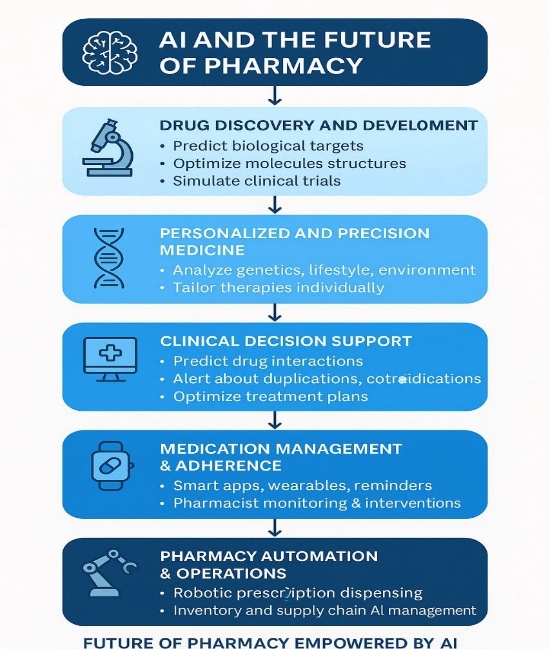
1.Future Directions of AI in Pharmacy Advanced Drug Discovery
AI will make drug target identification, virtual screening, and drug repurposing faster and more accurate. Expansion of Personalized Medicine: By combining genetic data, lifestyle information, and real-time health monitoring, AI will enable precision dosing and more customized treatments.
2. Smarter Clinical Decision Support
AI-based systems will provide real-time assistance to healthcare professionals, leading to better treatment decisions and improved patient safety.
3. Tele pharmacy Development
AI-enabled remote medication counseling and monitoring tools will improve access to healthcare services, especially in rural and remote areas.
4.Automation & Robotics
Pharmacies will increasingly adopt robotic dispensing and AI-driven inventory systems to boost efficiency and minimize errors.
5. Ethical AI & Regulatory Standards
New international guidelines will ensure data privacy, ethical AI use, and transparency in healthcare applications.
CONCLUSION
Pharmacy could undergo a revolution thanks to artificial intelligence (AI), but its successful integration depends on a well-thought-out plan. Its drawbacks must be addressed by concentrating on creating and implementing ethical AI, guaranteeing strong data security and privacy, resolving potential biases through meticulous data selection and algorithm design, and preserving human oversight. (7) In order to ensure that technology helps, not impedes, the provision of effective and compassionate patient care, the future of AI in pharmacy will require utilizing AI to supplement human interaction rather than to replace it.
REFERENCES

Prajakta Pawar*, Priyanka Mudgan, Dhanshree More, Siddhi Kothare, Article Intelligence and Digital Transformation of Pharmacy, Int. J. of Pharm. Sci., 2025, Vol 3, Issue 11, 32-36 https://doi.org/10.5281/zenodo.17499397
 10.5281/zenodo.17499397
