
View Article

Abstract

Solid oral dosage forms, particularly tablets, remain the predominant choice in pharmaceutical therapy due to their ease of administration, patient acceptance, and cost-effectiveness. Nevertheless, the tablet manufacturing process is susceptible to various quality compromises that can arise from multifactorial origins including raw material characteristics, formulation composition, granulation methodology, and equipment performance. Contemporary pharmaceutical literature identifies a spectrum of defects—including surface separation phenomena (capping and lamination), structural integrity issues (cracking and chipping), adhesion-related complications (sticking, picking, and binding), appearance abnormalities (mottling), and impression irregularities—that can significantly impact product. The integration of preventive quality assurance mechanisms, adoption of continuous improvement methodologies, and implementation of rigorous environmental monitoring systems enables pharmaceutical manufacturers to substantially reduce batch-to-batch variability and achieve consistent product specifications. This synthesis of recent peer-reviewed literature underscores that successful tablet quality management requires coordinated optimization across formulation design, process execution, equipment utilization, and manufacturing infrastructure, thereby advancing both product excellence and regulatory compliance in the pharmaceutical industry.

Keywords

Tablet defects, Remedies, Causes, etc.

Introduction

Pharmaceutical tablets represent the most widely prescribed solid oral dosage form globally, accounting for over 70% of all medications dispensed due to their convenience, stability, patient compliance, and cost-effective Manufacturing. Despite significant technological advancements in tableting processes, manufacturing defects remain a persistent challenge that can compromise product quality, therapeutic efficacy, and patient safety. These defects may arise at various stages of production, ranging from formulation development and granulation to compression and coating processes.

The pharmaceutical industry continues to face multifaceted challenges in tablet manufacturing, with defects stemming from formulation issues, machine-related problems, environmental factors, and human errors. Recent years (2023-2025) have witnessed considerable research efforts focused on understanding the root causes of these defects and developing innovative solutions, including the integration of artificial intelligence and automated inspection systems for defect detection. This comprehensive review examines the most common tablet manufacturing defects encountered in pharmaceutical production, their underlying causes, and evidence-based remedies as reported in recent literature .

 Classification of Tablet Defects :-
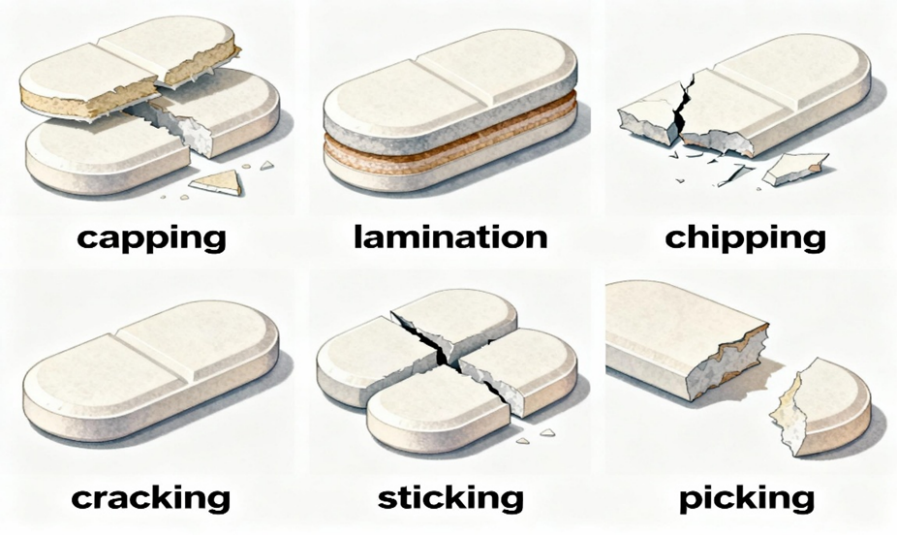
Tablet defects can be broadly classified into three major categories based on their origin.

  1. Process-Related Defects: Capping, lamination, cracking, and double impression
  2. Excipient/Formulation-Related Defects: Sticking, picking, binding, mottling, and chipping
  3. Machine-Related Defects: Weight variation, hardness variation, and equipment-specific issues

Major Tablet Defects: Causes and Remedies

  1. Capping

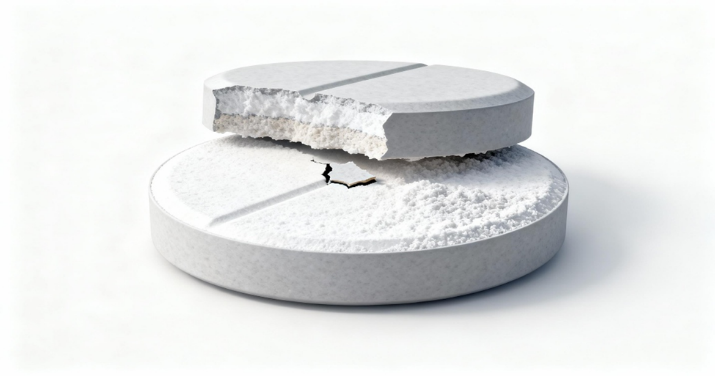
Definition: Capping is the partial or complete separation of the top or bottom portion of a tablet from the main body, occurring either during ejection from the die or during subsequent handling and coating operations.

Characterized by the partial or complete separation of the top or bottom portion of a tablet from its main body. This phenomenon usually occurs during the ejection of the tablet from the die or during subsequent handling and coating operations.
Causes:

Formulation-Related:

  • Air entrapment in granular material during compression with inadequate escape during decompression.
  • Excessively dry granulation or insufficient moisture content (loss of proper binding action).
  • High concentration of fines in the granules
  • Inadequate or inappropriate binder selection
  • Insufficient or incorrect lubrication.
  • Granular mass too cold to compress effectively.

Machine-Related:

  • High turret speed reducing dwell time.
  • Excessive compression pressure causing tablet cracking.
  • Deep concave punches or beveled edges.
  • Lower punches positioned too low during ejection.
  • Improperly adjusted sweep-off blade.
  • High humidity in manufacturing environment.

Remedies:

Formulation Approaches:

  • Remove fines using 100-200 mesh screens.
  • Moisten granules appropriately; add hygroscopic substances (sorbitol, methylcellulose, or PEG-4000).
  • Increase or change binder type and concentration.
  • Add dry binders such as hydrophilic silica, gum acacia, powdered sorbitol, PVP, or pre-gelatinized starch.
  • Modify lubricant type or increase dosage.
  • Control room temperature appropriately.

Machine Adjustments:

  • Reduce turret speed to increase dwell time.
  • Implement pre-compression stage to allow air escape.
  • Adjust compression force to optimal levels.
  • Polish dies carefully and use appropriate steel grades.
  • Use flat punches instead of deeply concave designs.
  • Set proper lower punch position for ejection.
  • Control humidity levels (40-50%) in manufacturing environment.

2. Lamination

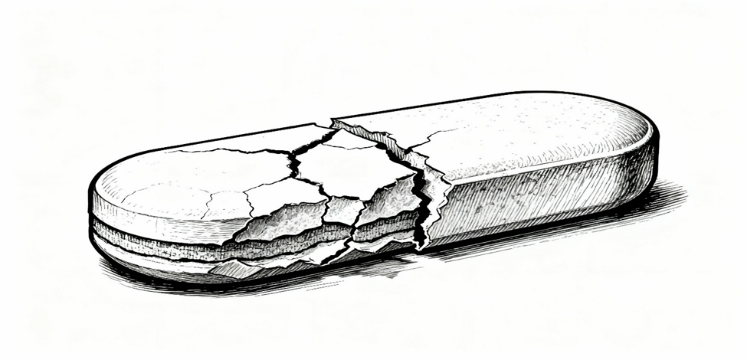
Definition: Lamination refers to the horizontal separation of a tablet into two or more distinct layers, typically occurring during or immediately after Compression.

As a result, the tablet loses its structural integrity, leading to separation along planes parallel to its surface. Understanding lamination is important because it affects not only the tablet’s appearance and mechanical strength but also its uniformity and overall quality.
Causes:

Formulation-Related:

  • Air entrapment during compression with subsequent release during ejection.
  • Presence of oily or waxy materials in granules.
  • Excessive use of hydrophobic lubricants (e.g., magnesium stearate).
  • High turret speed exacerbating the condition

Machine-Related:

  • Rapid decompression
  • Fast relaxation of tablet edge regions during ejection
  • Inadequate pre-compression

Machine Adjustments:

  • Use tapered dies with 3-5 degree outward taper in upper die bore.
  • Add pre-compression step to facilitate air removal.
  • Reduce turret speed.
  • Decrease final compression pressure.
  • Increase punch penetration depth to reduce air travel distance.
  • Manufacturing chemist reports emphasize that understanding strain-rate sensitivity of formulations is crucial, as some materials require slower turret speeds to prevent lamination.

Remedies:

Formulation Approaches:

  • Modify mixing process.
  • Add adsorbent or absorbent materials.
  • Reduce lubricant quantity or change lubricant type.
  • Optimize granule moisture content.

Machine Adjustments:

  • Use tapered dies with 3-5 degree outward taper in upper die bore.
  • Add pre-compression step to facilitate air removal.
  • Reduce turret speed.
  • Decrease final compression pressure.
  • Increase punch penetration depth to reduce air travel distance.

3. Sticking and Picking

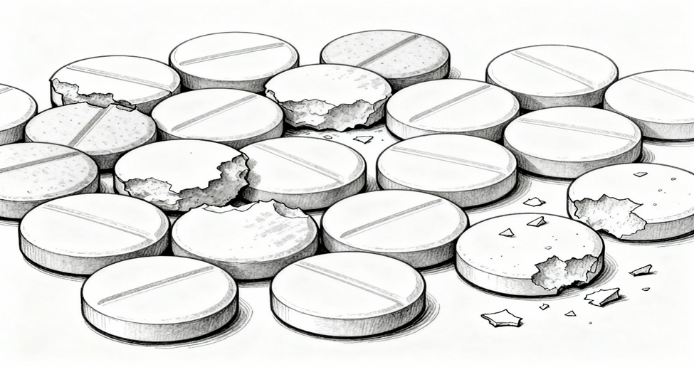
Definition: Sticking occurs when tablet material adheres to the die wall or punch faces. Picking is a specific type of sticking where small amounts of material adhere to embossed letters, logos, or punch face engravings, creating pitted surfaces on tablets.

This adhesion happens because the particles of the tablet formulation bond to the metal surfaces, often due to factors such as moisture, inadequate lubrication, or rough tool surfaces.
Causes:

Formulation-Related:

  • Incompletely dried granules or excessive moisture.
  • Insufficient lubricant content.
  • Hygroscopic granular materials.
  • Use of oily or waxy materials.
  • Too soft or weak granules.
  • Materials with low melting points that soften during compression.
  • Excessive binder content.

Machine/Tooling-Related:

  • Rough or scratched punch faces.
  • Excessively deep concavities or embossing.
  • Bevels or dividing lines too deep.
  • Compression speed (TPM) too high or too low.
  • Heated punches from poor lubrication.
  • Inappropriate pre-compression settings.

Remedies:

Formulation Approaches:

  • Dry granules properly and conduct moisture analysis.
  • Increase or change lubricant type.
  • Reduce binder amount or use different binder type.
  • Add absorbent materials.
  • Cool granules before compression.
  • Use magnesium oxide as "polishing" agent.
  • Control humidity in compression area.

Tooling/Design Solutions:

  • Polish punch faces to high luster.
  • Use chromium-plated steel with superior release properties.
  • Design lettering as large as possible.
  • Reduce depth and sharpness of engravings.
  • Use shallow concave or flat punches.
  • Implement pre-picking for enclosed letter areas (islands).
  • Use Sans Serif fonts instead of ornate Serif fonts.
  • Ensure proper punch maintenance and replacement.
  • Recent industry guidance  recommends that letter height should be at least 5-7.5 times the stroke width, with inside corner fillets having radii of at least 20% of stroke width to minimize picking.

4. Chipping

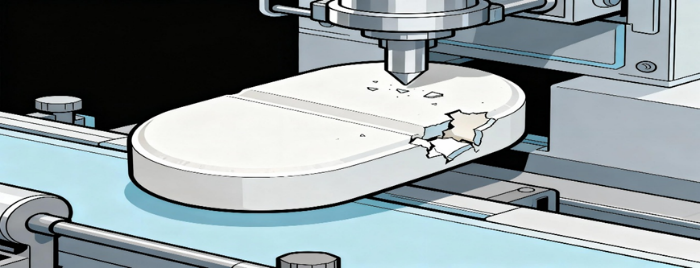
Definition: Chipping refers to the breaking or removal of tablet edges during ejection from the press, or during subsequent coating and handling operations.

Chipping is a tablet manufacturing defect characterized by the breaking or removal of small pieces from the edges of the tablet. This damage often occurs during the tablet’s ejection from the press or during subsequent processes such as coating and handling.

The causes of chipping include poor formulation factors like excessive or insufficient binding, overly dry granules which reduce plasticity, and mechanical issues such as worn or damaged punches and dies.

For example, worn die grooves or inward-turned punch edges can cause uneven compression, leading to cracks and chips on the tablet edges.
Causes:

Formulation-Related:

  • Excessively dry or brittle granules.
  • Too much binding agent causing bottom chipping.
  • Low moisture content.

Machine-Related:

  • Barrelled die (centre wider than ends).
  • Punch face edge turned inward.
  • Die groove worn at compression point.
  • Improper ejection take-off settings.
  • Worn or damaged punches and dies.
  • High compression force.

Remedies:

Formulation Approaches:

  • Optimize moisture content in granules.
  • Moisten granules to plasticize them.
  • Add hygroscopic substances.
  • Increase lubrication.
  • Use proper binders or dry binders.

Machine Adjustments:

  • Polish die to open finish and make cylindrical.
  • Reverse or replace worn dies.
  • Polish punch edges.
  • Reduce concavity of punch faces or use flat punches.
  • Regularly inspect and maintain punches and dies.
  • Adjust compression force appropriately.

5. Cracking

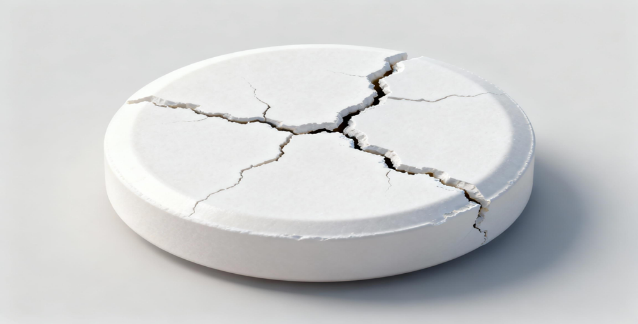
Definition: Cracking manifests as fine fissures or cracks on the upper and lower central surfaces of tablets, or occasionally on the sidewalls

Cracking appears as fine fissures or cracks typically on the upper and lower central surfaces of tablets, and sometimes on the sidewalls. This defect is mainly caused by rapid expansion of tablets after compression, often due to the use of very dry granules, improper binder content, or excessive compression pressure.

Air entrapment within the tablet during ejection can also contribute by causing the tablet to expand suddenly, leading to stress and cracking. Additionally, deep concave punches and worn or damaged tooling can exacerbate the problem by creating uneven stresses. Cracking may be worsened by brittle excipients or coating stresses and can sometimes be visible only under close inspection.
Causes:

Formulation-Related:

  • Excessively large granules.
  • Too dry or too moist granules.
  • Inadequate or inappropriate binder.
  • Granulation too cold.
  • Elastic excipients in granules.
  • Rapid expansion of tablets, especially with deep concave punches.

Machine-Related:

  • Air entrapment during compression causing tablet expansion on ejection.
  • Deep concavities in punches.
  • Over-compression.

Remedies:

Formulation Approaches:

  • Moisten or dry granules appropriately
  • Add appropriate amount of binder.
  • Reduce granulate size using sifter screens.
  • Improve granulation and add dry binders.
  • Replace or reduce elastic excipients.
  • Compress at room temperature.

Machine Adjustments:

  • Use tapered dies.
  • Decrease punch concavity depth.
  • Adjust compression force.
  • Use pre-compression to facilitate air escape.

6. Binding

Definition: Binding occurs when tablets stick, seize, or tear within the die, impeding ejection and potentially causing side fractures.

This problem can lead to side fractures and deformed tablets. Binding is primarily caused by insufficient lubrication of the die, excessive moisture in the granules, excessive compression pressure, or worn and damaged tooling surfaces.

When the die walls are rough or lubrication is inadequate, the tablet adheres to the die, making ejection difficult. Additionally, excessive moisture can cause the tablet to stick, while too much compression force or limited die clearance can increase this effect.

Causes:

Formulation-Related:

  • Excessively moisture in granules.
  • Insufficient or inappropriate lubrication.
  • Excessive binder content.
  • Granular material too warm.
  • Extremely abrasive granular material damaging dies.

Machine-Related:

  • Rough and poorly finished dies.
  • Undersized dies due to abrasion.
  • Inadequate clearance between punch and die.
  • Excessive compression pressure.

Remedies:

Formulation Approaches:

  • Dry granules properly and perform moisture analysis.
  • Use sufficient and effective lubricant.
  • Use appropriate binder amount.
  • Reduce granule size if too large.
  • Use wear-resistant dies.
  • Control temperature and humidity in compression room.

Machine Adjustments:

  • Polish dies correctly.
  • Investigate alternative steel grades or materials.
  • Increase clearance between punch and die.
  • Reduce compression pressure.
  • Replace worn or undersized dies.

7. Mottling

Definition: Mottling is characterized by uneven colour distribution on tablet surfaces, with light or dark spots appearing on an otherwise uniform surface.

This occurs primarily when the colorants or pigments are not properly mixed or evenly distributed during the formulation process. Factors contributing to mottling include the use of differently coloured ingredients, dye migration during granulation or drying, improper blending, the presence of incompatible excipients, and uneven moisture content. Mottling not only affects the tablet’s aesthetic appeal but can also indicate inconsistencies in formulation or manufacturing.

Causes:

Formulation-Related:

  • Coloured drug with different colour than excipients.
  • Dye migration during drying.
  • Improperly dispersed coloured binder solution.
  • Improper mixing in direct compression.
  • Particle size variations affecting colour distribution.
  • Dirt in granular material or on punch faces.

Remedies:

Formulation Approaches:

  • Use suitable colouring agents.
  • Modify solvent system.
  • Change binder type.
  • Reduce drying temperature.
  • Reduce particle size to prevent segregation.
  • Add dry colorant during powder mixing stage.
  • Mix thoroughly after adding finely ground adhesives.
  • Add hot gel solution to prevent clumping with cold powder.
  • Ensure proper colour solution mixing.

8. Weight Variation

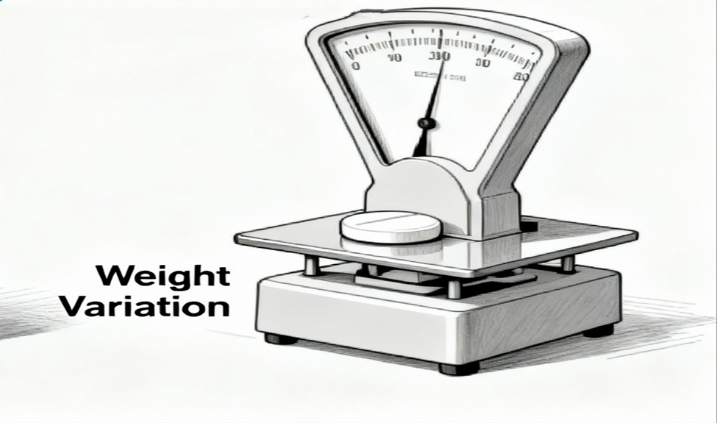
Definition: Weight variation occurs when individual tablet weights fall outside acceptable pharmacopoeial limits (typically ±5% for tablets >300mg)
Causes:

Formulation-Related:

  • High variation in bulk density and particle size distribution.
  • Poor granule flowability.
  • Inadequate glidant amount.
  • Product segregation during transfer.
  • Improper drying.

Machine-Related:

  • Poor or erratic flow from hopper.
  • Worn or aging machine parts.
  • Inappropriate feeder installation.
  • Mismatching between upper and lower punches.
  • Lower punch “hang up ”.
  • Press speed too fast with insufficient fill time.
  • Defective punch tooling.

Remedies:

Formulation Approaches:

  • Reduce weight variation through optimized granulation process.
  • Use additives to improve powder blend flowability (e.g., colloidal silicon dioxide).
  • Optimize particle size distribution.
  • Ensure proper drying.
  • Use sufficient glidant amount.
  • Prevent granule segregation during handling.

Machine Adjustments:

  • Adjust fill cam settings.
  • Maintain consistent powder level in hopper.
  • Regularly calibrate tablet press.
  • Inspect tooling for wear or damage.
  • Increase clearance between die wall and lower punch.
  • Reduce press speed or increase fill time.
  • Clean lower punch and die cavity regularly.
  • Statistical process control studies of 529 batches demonstrated that only 1% fell outside control limits, indicating that with proper controls, weight variation can be minimized effectively.

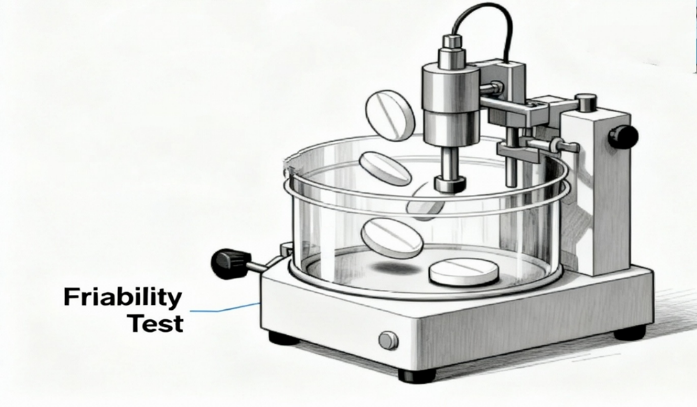
9. Hardness and Friability Problems

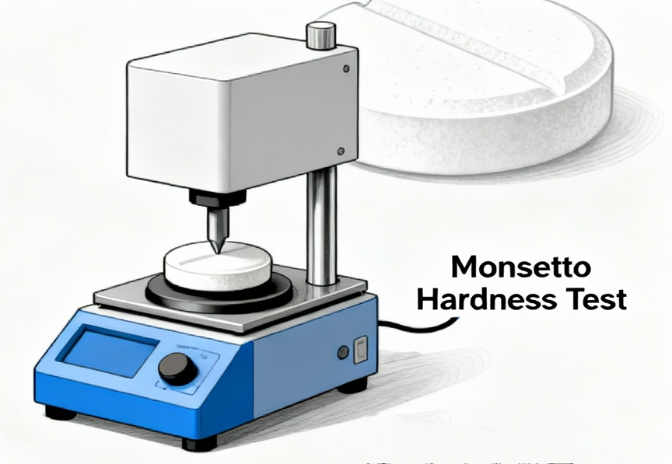
Definition: Hardness variation refers to inconsistent crushing strength across tablet batches. Friability measures tablet resistance to abrasion and breakage during handling, coating, packaging, and transport.
Causes:

Formulation-Related:

  • Variation in bulk density of granules.
  • Inadequate binder amount.r
  • Inhomogeneous particle size distribution.
  • Low moisture content affecting binding.

Machine-Related:

  • Worn or damaged tooling.
  • Compression force too low.
  • Improper ejection blade positioning.
  • Compression speed variations.

Remedies:

Formulation Approaches:

  • Use sufficient and effective binding agent.
  • Optimize granule adhesiveness.
  • Control moisture content (typically 2-4%).
  • Use high compactibility excipients like microcrystalline cellulose KG-1000.
  • Combine MCC with Starch 1500 for balanced hardness and disintegration.
  • Add 5% Ceolus™ KG-1000 to reduce coating friability.

Machine Adjustments:

  • Replace or repair worn tooling.
  • Increase compression force.
  • Fix ejection blade position properly.
  • Fine-tune rotation speed (slower speed provides more compaction force).
  • Maintain humidity at 40-50%.
  • Recent formulation studies (2020) confirmed that adding 5% high-compactibility MCC to tablet cores can reduce friability below 0.2% during film coating processes.

10. Double Impression

 Definition: Double impression occurs when overlapping imprints appear on tablet surfaces due to punch rotation during compression.

Causes:

  • Free rotation of upper or lower punches during ejection.
  • Lack of keying mechanism or anti-turning features.

Remedies:

  • Use keying in tooling (insert key alongside punch).
  • Employ modern presses with anti-turning mechanisms.
  • Regularly monitor punch alignment and clearance.
  • Evaluate punch design and adjust as required.

11. Blistering

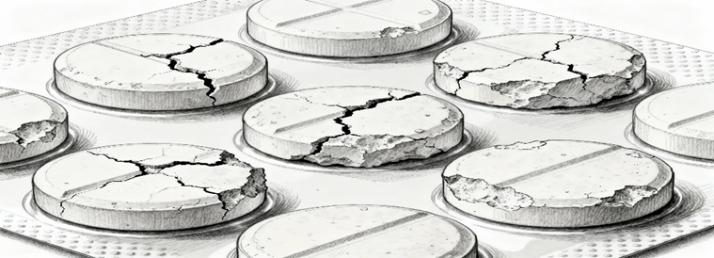
Definition: Blistering of a surface film occurs when its elasticity or adhesive properties are compromised. The result is that the film becomes detached from the tablet’s substrate.
Causes:

Blistering is usually a result of high temperatures that may occur during the drying process, during the spraying stage or at the end of the coating process

Remedies:

Use mild drying conditions, and ensure moderate temperatures at other stages of the coating process.

12. Cratering

Definition: Cratering happens when a defect on the film’s coating results in craters appearing on the tablet which in turn results in the exposure of the tablet’s surface.

Causes:

Cratering can occur in certain instances where there is insufficient drying time to seal the film or a high volume of coating solution is applied. In these cases excess polymer solution can penetrate to the surface of the tablet, especially in the crown area, causing the disruption of the coating and degeneration of the tablet’s core.

Remedies:

Check the efficiency of the drying process and optimise drying conditions

13. Pitting

Definition: Pitting refers to a defect in which the tablet core undergoes deformation or indentation, even though the film coating remains intact and shows no visible damage.

Causes:

This defect arises when the temperature of the tablet core exceeds the melting point of one or more ingredients used during formulation.

 Remedies:

Avoid preheating the tablets before coating begins. Adjust the drying or inlet air temperature to ensure that the tablet core temperature remains below the melting point of the formulation additives.

14. Blushing

Description: Blushing refers to the occurrence of a cloudy appearance or white specks on the film surface of a tablet.

Causes:

This defect occurs when polymer particles precipitate within the coating film, often due to an excessively high coating temperature. It can also result from polymer gelation when certain polymers are combined with incompatible materials.

Remedies:

Reduce the drying or inlet air temperature to prevent polymer precipitation. Avoid using sorbitol with polymers such as hydroxypropyl cellulose, hydroxy methyl cellulose, methyl cellulose, or other cellulose ethers.

Tablet Coating Defects

Recent comprehensive reviews  have highlighted numerous coating-specific defects.

Blistering:

Film detachment due to high drying temperatures – remedy with moderate drying conditions.

Blooming:

Dull tablet appearance from plasticizer migration – adjust plasticizer concentration.

Bridging:

Coating filling logos/intagliations – reduce viscosity, increase plasticizer, improve spray atomization.

Chipping/Edge Erosion:

Film wear at tablet edges – increase film hardness, optimize pan speed, modify tablet punch design.

Orange Peel:

Rough, non-glossy surface – reduce solution viscosity, use gentler drying conditions.

Picking (coating):

Material adherence in coating – ensure proper granule drying and lubrication.

Colour Variation:

Inconsistent coating colour – modify spray equipment, adjust spray rate.

CONCLUSION:

Tablet manufacturing defects remain a significant challenge in pharmaceutical production despite technological advances. Recent literature  emphasizes that successful defect prevention requires a multifaceted approach integrating optimized formulation design, precise machine control, environmental regulation, and comprehensive quality assurance systems.

Key strategies emerging from recent research include:

  • Implementation of AI-powered automated inspection and predictive analytics for early defect detection.
  • Adoption of innovative technologies such as lower punch vibration and advanced coating systems.
  • Use of high-performance excipients specifically designed to enhance tablet mechanical properties.
  • Integration of Process Analytical Technology (PAT) for real-time monitoring.
  • Application of Quality by Design (QbD) principles throughout development and manufacturing.

The pharmaceutical industry's continued focus on innovation, coupled with stringent regulatory oversight and adoption of emerging technologies, provides a pathway toward producing consistently high-quality, defect-free tablets that ensure patient safety and therapeutic efficacy. Future developments in artificial intelligence, continuous manufacturing, and personalized medicine will further transform tablet manufacturing, enabling more robust processes and superior product quality.

REFERENCES

  1. International Journal for Multidisciplinary Research (IJFMR), Volume 5, Issue 5, September-October 2023
  2. Richpacking020.com, Tablet Press Problems And Solutions, December 2022
  3.  Journal of Chemical and Pharmaceutical Research, 2025, 17(1):01-08  Pharmaguddu, Tablets Manufacturing Defects and Remedies, May 2024
  4.  SED Pharma, The Complete Guide to Tablet Manufacturing Processes, July 2025
  5.  International Journal of Pharmaceutics, A Novel Approach to Avoid Capping and/or Lamination, April 2020
  6. PharmTech, Solving Sticking and Picking Through Tablet Design, March 2025
  7. Tabletpress.co.in, Common Manufacturing Defects in Tablets and Remedies, November 2024
  8. Pharmapproach, Common Tablet Defects: Causes and Remedies, January 2024
  9. International Journal for Multidisciplinary Research (IJFMR). Volume 5, Issue 5, September-October 2023.
  10. Richpacking020.com. Tablet Press Problems And Solutions [Internet]. December 2022 [cited 2025 Nov 22]. Available from: http://richpacking020.com
  11. Journal of Chemical and Pharmaceutical Research. 2025;17(1):1-8.
  12. Pharmaguideline.com. Tablet Defects in Pharmaceutical Manufacturing [Internet]. March 2024 [cited 2025 Nov 22]. Available from: http://pharmaguideline.com
  13. SED Pharma. Common Problems & Solutions of Tablet Press in Production Process [Internet]. May 2025 [cited 2025 Nov 22]. Available from: http://sedpharma.com
  14. Overview.ai. Common Tablet Defects in Pharma Manufacturing [Internet]. September 2025 [cited 2025 Nov 22]. Available from: http://overview.ai
  15. LFA Tablet Presses. Common Problems in Tablet Compression [Internet]. July 2019 [cited 2025 Nov 22]. Available from: http://lfatabletpresses.com
  16. Biogrund. Top 10 Troubleshooting Guide Tableting [Internet]. August 2024 [cited 2025 Nov 22]. Available from: http://biogrund.com
  17. SlideShare. Tablet Coating Defects [Internet]. May 2018 [cited 2025 Nov 22]. Available from: http://slideshare.net
  18. LinkedIn. Causes and Solutions of Defects in Tablet Manufacturing [Internet]. April 2024 [cited 2025 Nov 22]. Available from: http://linkedin.com
  19. LFA Tablet Presses. 11+ Tablet Coating Defects and their Remedies [Internet]. March 2025 [cited 2025 Nov 22]. Available from: http://lfatabletpresses.com
  20. IAJPR. Artificial Intelligence (AI)-Based Detection of Tablet Defects.
  21. PharmTech. Troubleshooting Problems Affecting Tooling During Tablet Manufacture [Internet]. March 2025 [cited 2025 Nov 22]. Available from: http://pharmtech.com
  22. Pharmaguddu. Tablets Manufacturing Defects and Remedies [Internet]. May 2024 [cited 2025 Nov 22]. Available from: http://pharmaguddu.com
  23. SED Pharma. The Complete Guide to Tablet Manufacturing Processes [Internet]. July 2025 [cited 2025 Nov 22]. Available from: http://sedpharma.com
  24. PharmTech. Solving Sticking and Picking Through Tablet Design [Internet]. March 2025 [cited 2025 Nov 22]. Available from: http://pharmtech.com
  25. Tabletpress.co.in. Common Manufacturing Defects in Tablets and Remedies [Internet]. November 2024 [cited 2025 Nov 22]. Available from: http://tabletpress.co.in
  26. Pharmapproach. Common Tablet Defects: Causes and Remedies [Internet]. January 2024 [cited 2025 Nov 22]. Available from: http://pharmapproach.com

Reference

  1. International Journal for Multidisciplinary Research (IJFMR), Volume 5, Issue 5, September-October 2023
  2. Richpacking020.com, Tablet Press Problems And Solutions, December 2022
  3.  Journal of Chemical and Pharmaceutical Research, 2025, 17(1):01-08  Pharmaguddu, Tablets Manufacturing Defects and Remedies, May 2024
  4.  SED Pharma, The Complete Guide to Tablet Manufacturing Processes, July 2025
  5.  International Journal of Pharmaceutics, A Novel Approach to Avoid Capping and/or Lamination, April 2020
  6. PharmTech, Solving Sticking and Picking Through Tablet Design, March 2025
  7. Tabletpress.co.in, Common Manufacturing Defects in Tablets and Remedies, November 2024
  8. Pharmapproach, Common Tablet Defects: Causes and Remedies, January 2024
  9. International Journal for Multidisciplinary Research (IJFMR). Volume 5, Issue 5, September-October 2023.
  10. Richpacking020.com. Tablet Press Problems And Solutions [Internet]. December 2022 [cited 2025 Nov 22]. Available from: http://richpacking020.com
  11. Journal of Chemical and Pharmaceutical Research. 2025;17(1):1-8.
  12. Pharmaguideline.com. Tablet Defects in Pharmaceutical Manufacturing [Internet]. March 2024 [cited 2025 Nov 22]. Available from: http://pharmaguideline.com
  13. SED Pharma. Common Problems & Solutions of Tablet Press in Production Process [Internet]. May 2025 [cited 2025 Nov 22]. Available from: http://sedpharma.com
  14. Overview.ai. Common Tablet Defects in Pharma Manufacturing [Internet]. September 2025 [cited 2025 Nov 22]. Available from: http://overview.ai
  15. LFA Tablet Presses. Common Problems in Tablet Compression [Internet]. July 2019 [cited 2025 Nov 22]. Available from: http://lfatabletpresses.com
  16. Biogrund. Top 10 Troubleshooting Guide Tableting [Internet]. August 2024 [cited 2025 Nov 22]. Available from: http://biogrund.com
  17. SlideShare. Tablet Coating Defects [Internet]. May 2018 [cited 2025 Nov 22]. Available from: http://slideshare.net
  18. LinkedIn. Causes and Solutions of Defects in Tablet Manufacturing [Internet]. April 2024 [cited 2025 Nov 22]. Available from: http://linkedin.com
  19. LFA Tablet Presses. 11+ Tablet Coating Defects and their Remedies [Internet]. March 2025 [cited 2025 Nov 22]. Available from: http://lfatabletpresses.com
  20. IAJPR. Artificial Intelligence (AI)-Based Detection of Tablet Defects.
  21. PharmTech. Troubleshooting Problems Affecting Tooling During Tablet Manufacture [Internet]. March 2025 [cited 2025 Nov 22]. Available from: http://pharmtech.com
  22. Pharmaguddu. Tablets Manufacturing Defects and Remedies [Internet]. May 2024 [cited 2025 Nov 22]. Available from: http://pharmaguddu.com
  23. SED Pharma. The Complete Guide to Tablet Manufacturing Processes [Internet]. July 2025 [cited 2025 Nov 22]. Available from: http://sedpharma.com
  24. PharmTech. Solving Sticking and Picking Through Tablet Design [Internet]. March 2025 [cited 2025 Nov 22]. Available from: http://pharmtech.com
  25. Tabletpress.co.in. Common Manufacturing Defects in Tablets and Remedies [Internet]. November 2024 [cited 2025 Nov 22]. Available from: http://tabletpress.co.in
  26. Pharmapproach. Common Tablet Defects: Causes and Remedies [Internet]. January 2024 [cited 2025 Nov 22]. Available from: http://pharmapproach.com

Photo
Sofiya Pathan
Corresponding author

Shivlingeshwar College of Pharmacy, Almala, Latur, Maharashtra

Photo
Asmita Ingale
Co-author

Shivlingeshwar College of Pharmacy, Almala, Latur, Maharashtra

Photo
Vidya Kapse
Co-author

Shivlingeshwar College of Pharmacy, Almala, Latur, Maharashtra

Photo
Dr. V. M. Dharashive
Co-author

Shivlingeshwar College of Pharmacy, Almala, Latur, Maharashtra

Sofiya Pathan, Asmita Ingale, Vidya Kapse, Dr. V. M. Dharashive, A Review Article on Tablet Defects and Their Remedies, Int. J. of Pharm. Sci., 2025, Vol 3, Issue 12, 3406-3418. https://doi.org/10.5281/zenodo.18022168

More related articles
Comprehensive Review: Bempedoic Acid and Ezetimibe...
Mahima Bijewar, Dinesh Kawade, Chetna Kapgate, Achal Gadhwale, Ad...
Formulation and Characterization of Risperidone Su...
Shivani Yadav, Avinash Kondalkar, Shankar, Narottam Singh, Murare...
Peptic Ulcer Disease and Screening Approaches: A C...
Rynu Tom Thykkaden, Fatiima Mehrin, Avani Santhosh, Vrinda R, ...
A Review on Herbal Face Pack...
Neha Rathod, Sabafarin Hasin Shaikh, Rahul Rathod, Samadhan Chavan, Mohammad Sufiyan, Sushmita Chava...
Microneedles: A Smart Approach for Advanced Drug Delivery – A Review...
Sakshi Ghorpade, Aparna Sawant, Shruti Gosavi, Hrutuja Chavan, Amrita Singh, ...
Related Articles
Polymers Used in Diabetic Complications: A Review ...
Shaikh Ramiz Rafik, Belure M. S., ...
A Review on Anti-Inflammatory Agents obtained from Natural Sources...
Falguni Kulthi, Sneha Kanase, Suruchi Bedmutha, Archana Garudkar, Gayatri Gadve, Shambhuraje Raut, ...
Comprehensive Review: Bempedoic Acid and Ezetimibe Fixed-Dose Combination in Hyp...
Mahima Bijewar, Dinesh Kawade, Chetna Kapgate, Achal Gadhwale, Aditi Tayde, Neha Sharnagate, ...
More related articles
Comprehensive Review: Bempedoic Acid and Ezetimibe Fixed-Dose Combination in Hyp...
Mahima Bijewar, Dinesh Kawade, Chetna Kapgate, Achal Gadhwale, Aditi Tayde, Neha Sharnagate, ...
Formulation and Characterization of Risperidone Sustained Release Buccal Tablets...
Shivani Yadav, Avinash Kondalkar, Shankar, Narottam Singh, Muraree Lal, ...
Peptic Ulcer Disease and Screening Approaches: A Comprehensive Review...
Rynu Tom Thykkaden, Fatiima Mehrin, Avani Santhosh, Vrinda R, ...
Comprehensive Review: Bempedoic Acid and Ezetimibe Fixed-Dose Combination in Hyp...
Mahima Bijewar, Dinesh Kawade, Chetna Kapgate, Achal Gadhwale, Aditi Tayde, Neha Sharnagate, ...
Formulation and Characterization of Risperidone Sustained Release Buccal Tablets...
Shivani Yadav, Avinash Kondalkar, Shankar, Narottam Singh, Muraree Lal, ...
Peptic Ulcer Disease and Screening Approaches: A Comprehensive Review...
Rynu Tom Thykkaden, Fatiima Mehrin, Avani Santhosh, Vrinda R, ...