
Vidyaniketan Institute of Pharmacy and Research Center, Bota
Breast cancer has become the most commonly diagnosed type of cancer in recent years. It is the biggest health threat for women when it comes to both the number of cases and deaths. In 2020, over 2.3 million women around the world were diagnosed with breast cancer, and more than 6.85 million women died from it. In this discussion, we will focus on TNBC, which is the most difficult type of breast cancer to treat. Because of this, there is an urgent need for new and better treatment options. Traditional treatments like chemotherapy and radiation therapy have limits when it comes to how well they work. So, new and more targeted ideas are being developed to find better solutions. Triple-negative breast cancer (TNBC) is currently the most complex and hardest to treat form of breast cancer. Even though chemotherapy is still the main treatment used, there has been a lot of research into new therapies because TNBC has a poor outlook and a high risk of coming back after treatment. Breast cancer is the most common type of cancer diagnosed and the main reason women die from cancer worldwide, which poses a serious threat to women's health. Treating breast cancer needs a team of different specialists and considers the size of the tumor and certain markers in the cancer cells. For early-stage breast cancer, the usual treatments are either surgery to remove just the affected part of the breast along with radiation or removing the entire breast. Whether to give additional treatments like chemotherapy or hormone therapy depends on factors such as whether the cancer has spread to the lymph nodes, if the cancer cells have hormone receptors, and if they have a protein called HER-2. For breast cancer that has spread to other parts of the body, the focus is on extending the patient’s life and keeping their quality of life as high as possible.
Even though there have been big advances in cancer research, breast cancer is still a major health problem and is a top focus for biomedical studies. In the coming years, it's expected that both the number of cases and deaths from breast cancer will increase around the world. Recently, breast cancer has become a big topic for researchers. New data shows that breast cancer is the most common cancer that causes death in women under the age of 45. Triple-negative breast cancer (TNBC) has complex biological features and is very varied. However, age doesn't affect how it's managed, what advice is given, or what treatment options are available. The complicated biology of this cancer is still not well understood [1]. Women with breast cancer are usually treated with a mix of surgery, chemotherapy, and radiation. To lower side effects and improve survival rates, new research is focusing on personalized treatment plans [2]. Even with recent progress in cancer treatment, the past decade has seen slow progress in breast cancer care. This has only slightly improved survival times for those with advanced disease. This is partly because current targeted therapies have big limitations. Reasons for high resistance to these drugs include their short-lived effects and the difficulty in explaining differences between people and within tumors. Understanding this complex variety is key in the fight against breast cancer spreading and forming new tumors [3].
Breast cancer is the most common type of cancer diagnosed in women and is the main reason for cancer-related deaths. According to a 2023 prediction, there were about 300,590 new cases and 43,700 deaths from invasive breast cancer in the United States. This accounts for roughly 30% of all cancers affecting women. The treatment options for breast cancer include surgery, chemotherapy, radiation therapy, hormone therapy, targeted therapy, and immunotherapy. These treatments often require the collaboration of several medical specialists [4]. For breast cancer that has not spread, surgery is the main treatment. Chemotherapy given before surgery can help shrink the tumor, making it possible to save more breast tissue and reduce the need for removing lymph nodes from the underarm area [5]. For cancer that has spread, systemic treatment is usually the best option, and surgery is typically only used to relieve symptoms in specific cases. Improvements in hormone therapy, targeted therapy, and immunotherapy have given more treatment choices for both early and advanced stages of breast cancer [6]. Some new treatments are also being studied, like gene therapy, vaccines, and cell-based therapies such as T cell receptor therapy and chimeric antigen receptor T (CAR-T) therapy, which have shown encouraging results. This review will cover the current state of various treatments for breast cancer, including surgery, chemotherapy, radiation, hormone therapy, targeted therapy, immunotherapy, gene therapy, and other new approaches, with the goal of helping doctors make better treatment decisions [7].
Breast cancer happens when unusual cells in the breast start growing and multiplying too much, creating a mass or tumor. It is among the most frequent types of cancer in women around the world. Finding it early and getting treatment can greatly increase the chances of survival. There are different kinds of breast cancer, and factors that can raise the risk include family history, age, and how someone lives their life. Some signs to watch for are a lump in the breast, changes in its shape, or fluid coming from the nipple. Ways to treat it include surgery, chemotherapy, radiation, and hormone therapy. Doing regular check-ups and examining your own breasts can help catch breast cancer early [8].
Breast cancer is still a major challenge in global health, with its complex development and varied symptoms making it hard to treat and prevent. As more people are being diagnosed with this disease around the world, it's crucial to better understand all the factors involved in breast cancer to create better treatment options [9].
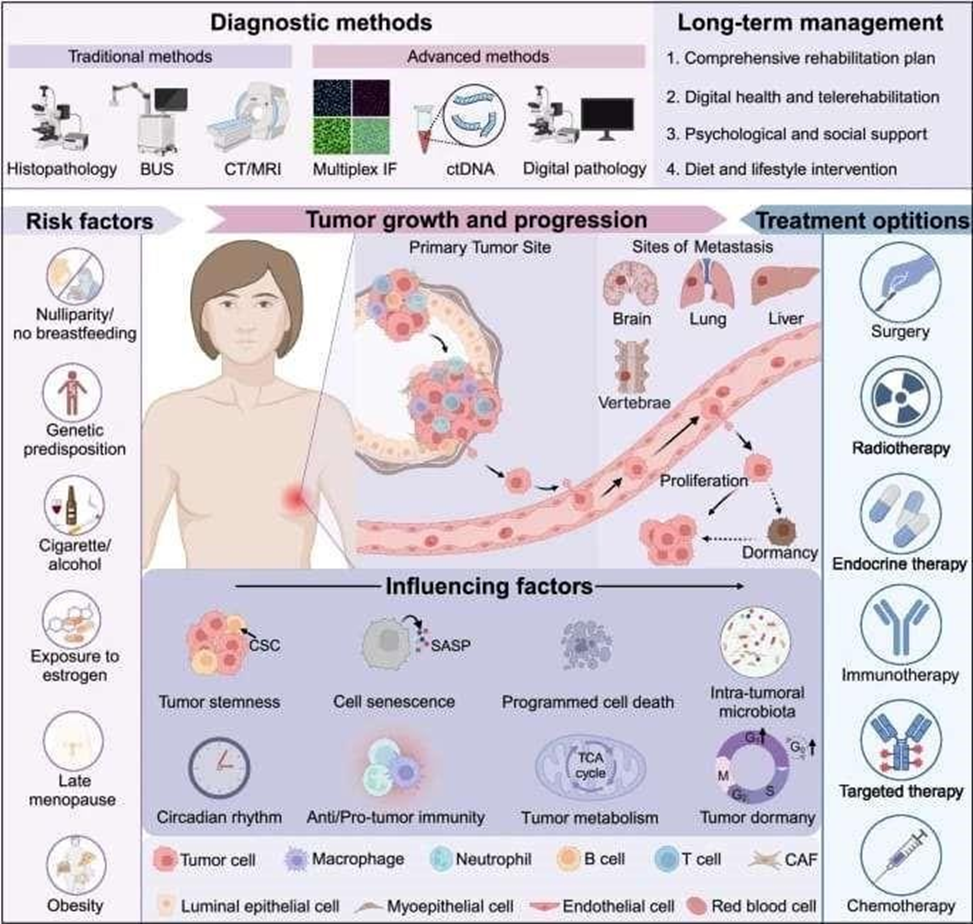
Fig.1.Overview of breast cancer
Breast cancer is one of the most common types of tumors in women, and its development is linked to many factors, including genetic changes, late menopause, and obesity. How breast cancer progresses depends on several things, such as the features of the cancer cells and the environment around the tumor, which can include both living and non-living parts. In recent years, there have been major improvements in the ways breast cancer is diagnosed [10]. Along with standard imaging methods and lab tests, newer approaches like liquid biopsy, multiple immunofluorescence tests, and digital pathology are now being used more in real-world medical settings. There are many different treatments available for breast cancer, and recent studies highlight the value of tailoring treatment plans to each patient's specific situation. Ongoing care for breast cancer patients is also very important, as it can affect how well treatments work and help improve their overall quality of life. BUS B-scan ultrasonography, CT computed tomography, MRI magnetic resonance imaging, IF immunofluorescence, catena circulating tumor DNA, CSC cancer stem cell, SASP senescence- associated secretory phenotype, TCA cycle tricarboxylic acid cycle [11].
Therapy of breast cancer:
Chemotherapy:
Chemotherapy approaches for breast cancer include neoadjuvant chemotherapy (NAC), adjuvant chemotherapy (AC), and salvage chemotherapy. Giving chemotherapy can lower the chance of cancer coming back by about 30% in early-stage breast cancer. NAC can shrink the tumor and lymph nodes, making it possible to perform breast-sparing surgery in some cases, turn inoperable cancer into one that can be treated, and remove tiny cancer cells that have spread. NAC is often recommended for patients with large tumors, multiple affected lymph nodes, and aggressive cancer types, especially those that are triple-negative or HER2-positive. Using NAC in these aggressive types helps check how well the treatment is working, predicts the cancer's likely course, and helps decide the next steps in treatment [12]. Earlier studies found that giving NAC before surgery led to similar chances of local recurrence and survival compared to surgery first followed by chemotherapy, but it also reduced the need for mastectomy by about 17%. NAC or AC should be given to high-risk patients, such as those with large tumors, involved lymph nodes, low hormone receptor expression, younger age, or lymph-vascular invasion. Using a sandwich chemotherapy approach should be avoided unless it's part of a clinical trial. Also, multi-gene tests and molecular classifications can help identify which patients might benefit from chemotherapy, especially for those with node-negative, hormone receptor-positive, triple-negative, or HER2positive cancers [13].
Gene Therapy:
Gene therapy is a hopeful method for treating cancers. It works by delivering genetic material through a vector into specific cells, allowing the genes to be edited and changing how the gene's product is made. This helps in treating cancer. Some strategies used in gene therapy include gene editing, targeting transcription factors, microRNA, and breast cancer cells, as well as DNA or RNA vaccination. In a Phase I clinical trial, the safety and effectiveness of a genetic pro-drug activation therapy aimed at the human HER-2 gene promoter were tested. The study included 12 breast cancer patients, and the results showed that the method was safe, with gene expression detected in up to 90% of patients [14]. Another Phase II trial involved 28 patients with metastatic TNBC to examine the benefits of in situ virus gene therapy (ADV/HSV-to) combined with stereotactic body radiotherapy and pembrolizumab. The results showed a clinical benefit rate of 21.4%, with patients who had a good response showing long-lasting effects, including improved median treatment duration (9.6 months) and overall survival (14.7 months). The use of microRNA in cancer treatment has also shown promise in slowing down the growth and spread of breast cancer cells. MRX34, as far as we know, is one of the first miRNA replacement drugs (miR-34a) and is now undergoing clinical trials [15].
Types of Breast Cancer:
Risk Factors:
Symptoms:
Diagnosis and Treatment: -
CONCLUSION
After lung cancer, breast cancer is the second leading cause of cancer deaths in women in the United States. Factors that can increase the risk include getting older, being overweight, drinking too much alcohol, having a family history of the disease, and past exposure to radiation. With recent advances in immunology, there's hope that CAR-T therapy could be a promising treatment. This type of therapy uses special cells called CAR-T cells to fight the harmful effects of the tumor's environment. This review looks at how safe and effective CAR-T cell treatment can be for breast cancer through a process called adoptive cell transfer.
REFERENCES

Pakale Akshada, Kirve Megha, Recent Advancement in The Treatment of Breast Cancer, Int. J. of Pharm. Sci., 2025, Vol 3, Issue 10, 2763-2768. https://doi.org/10.5281/zenodo.17447692
 10.5281/zenodo.17447692
