
Dattakala College of Pharmacy, Swami Chincholi, Daund, Pune
Phytosoconstituents, in modern time phytosomes are being increase the level of natural remedies. It is recently introduced system to have used as a novel drug delivery. However nowadays it has been developed into the most well-turned and self assembled system to raise the oral bioavailability of phyto-drug. That generally recognized as phytosomes. Phytoconstituents have a benignant moderation between hydrophilic and lipophilic in nature molecules which is helps in breakdown of gastro-intestinal sap to pass the lipid rich bio-membrane of cells. It can just be achieved as a result of phytosomes technique. But the delivery of herbal drugs is turn into the challenges owing to reduced aqueous dissolubility, poor permeations and foremost metabolite rate. Therefore, phytosome works as linkage for retain the efficiency toward develop the incorporation of numerous well-linked herbal drugs. E.g. Ginkagobiloba, grape seeds, green tea etc. it can merely be evolved for a variety of remedial use.
Novel drug delivery system is a novel approach to drug that addresses the limitations of the traditional drug delivery system. Our country has a vast knowledge base of Ayurveda whose potential is only being realized in the recent years. If the novel drug delivery technology is applied in herbal medicines, it may help in increasing the efficacy and reducing the side effects of various herbal compounds and herbs. This is basic idea behind incorporating novel method of drug delivery in herbal medicines. Thus, it is important to integrate novel drug delivery system and Indian medicines to combat more serious diseases. For a long period of time herbal medicines were not considered for development as novel formulations owing to lack of scientific justification and processing difficulties, such as standardization, extraction and identification of individual drug components in complex polyherbal systems.
Selection of herbal drug and novel drug delivery system
According to WHO data, more than 85% of world population is directly or indirectly using plant based medicines. On this background, it is very important to select the right plant material for development of herbal drug. The selection of species or botanical varieties specified in the pharmacopoeia or other authorities' documents of other countries should be considered. Selection of herbal medicinal plant can be done by various approaches like,
Randomized approach: Three randomized clinical trials of individualized herbal medicine where identified. Statistically non- significant trends favoring active over placed treatment.
Ethano-boatanical approach: Ethan botany, as a research field of science has been widely used for the documentation of indigenous knowledge on the use of plants and for providing on inventory of useful plants from local flora in Asian Countries plants that are used for traditional herbal medicine in different countries are in important part of these studies.
Properties of Herbal NDDS
Physicochemical properties
1. Solubility: Solubility is a one of the important parameter to achieve desired concentration of drug in systemic circulation for achieving required pharmaceutical response. Poorly water soluble drug often required high doses in order to reach therapeutic concentration after oral administration.
2. Partition Coefficient: The partition coefficient is the measure of the lipophilicity of a drug and an indication of its ability to cross the cell membrane. It is defined as the ratio between the organic and aqueous layers at equilibrium.
3. Dissociation constant: A quantity expressing the extent to which a particular substance in solution is dissociated into ions, equal to the product of the concentration of respective ions divided by the concentration of the undissociated molecule.
4. Hydrogen Bonding: Hydrogen bonding, interaction involving a hydrogen atom located between a pair of other atoms having a high affinity for electrons, such as bond is weaker than an ionic bond or covalent bond but stronger than Van Der Waals forces.
5. Ionization of drug: Most drug molecules ionize in aqueous solution to give weakly acidic or basic solution.
6. Redox potential: Redox potential is measure of the easy with which a molecule will accept electron, which means that the more positive the redox potential the more readily a molecule is reduced.
7. Complexation: Complexation is the combination of individual atom group, ions or molecules to create one large or molecule one atom or ion is the focal point of the complex.
8. Surface activity: The strong absorption of such material at surface or interfaces in the form of an orientated monomolecular layer is termed surface activity. Surface active material consists of molecules containing both polar and non-polar parts.
9. Protein binding: Plasma protein binding refers to the degree to which medication attach to protein within the blood. A drug's efficiency may be affected by the degree to which it binds. The less bound a drug is, the more efficiently it can transverse or diffuse through a cell membrane.
10. Isosterism: At that time the word Isosterism was used to describe the similarity of molecules or ions which have the same number of atoms and valence electron, compounds or groups of atoms having the same number of atom and electrons.
Literature Survey
Biological Properties
1. Absorption: The process of taking nutrients from the digestive system into the blood so they can be used in the body.
2. Distribution: Distribution in pharmacology is a branch of pharmacokinetics which describe the reversible transfer of the drug from one location to another within the body. Once a drug enters to the systemic circulation by absorption or direct administration. It must be distributed into intestinal and intracellular fluids.
3. Metabolism: Metabolism is the process that converts the fuel in the food we eat into energy, the body can use to metabolize is to produce a substance by metabolism.
4. Elimination: Drug elimination is the sum of the processes of removing and administered drug from the body. In the pharmacokinetic ADME. It is frequency considered to encompass both metabolism and excretion.
5. Biological half-life: The duration of action of a drug is known as its half-life. This is the period of time required for the concentration or amount of drug in the body to reduce by one half.
6. Side effects: Side effects also known as adverse reaction are unwanted undesirable effects that are possibly related to a drug, side effect can vary from minor problems like a runny nose to life- threatening events, such as a heart attack or liver damage.
7. Safety consideration: Safety precaution means general activities that include, but are not limited to, wearing gloves, wearing eye protection, using equipment that is in good repair cleaning up spills, access to a first aid kit etc.
Current Challenges in upgrading and modernization of herbal formulation
In spite of global recognition and very sound history of traditional uses, promotion challenges around the global mainly in development nation. Following are the problems need to be overcome before the promotion of traditional herbal knowledge around the world.
1. Quality issues: Adulteration, misidentification of plant, faulty collection and preparation, in correct formulation process are the main problems that reduces the effectiveness of herbal preparation and can be considered as a key factors affecting quality and purity of herbal medicines.
2. Processing and harvesting issues: Indiscriminate harvesting, poor agriculture and propagation method, poor pre and post harvesting practices lack of processing techniques leads to the substandard quality of herbal drug.
3. Quality control related issues: Standardization, poor quality control procedure and lack of GMP are the main hurdle to maintain the quality of herbal drugs. Lack of awareness regarding the guidelines among growers and manufactures, lack of implementation and regulation of the guidelines are also frequent in small and medium scale industries.
Phytosomes
The term "Phyto" means plant while "some" means cell-like. Phytosomes are little cell like structure. Phytosomes technology was invented by Indena in 1989. Phytosomes are novel drug delivery system containing hydrophilic bioactive phytoconstituents of herbs surround and bound by phospholipids Phytomedicines are complex chemical mixture prepared from plants. Water soluble phytoconstituents (Flavonoids) are poorly absorbed. Many phytoconstituents such as flavonoids and various phenolic compounds are known to have antioxidants, anti-inflammatory, anti-cancer and weight loss effects but their full therapeutic efficacy cannot be obtain due their poor systemic bioavailability own to their poor absorption from the GIT tract. Phytopharmaceuticals are healing the world from millions and billions of years even thought their clinical validation is questioned by virtue of their impediments like low lipid solubility, poor stability, large size moiety and needless metabolism in gut. Phytosome technology has emerged as committed and promising targeting novel drug delivery with improved efficacy, quality and target ability of active plant constituents. Novel herbal formulations techniques have assured the researchers to deliver the plant based secondary metabolites to their systemic targets. This review highlights the unique properties of phytophospholipid complex along with their application in novel natural drug delivery.
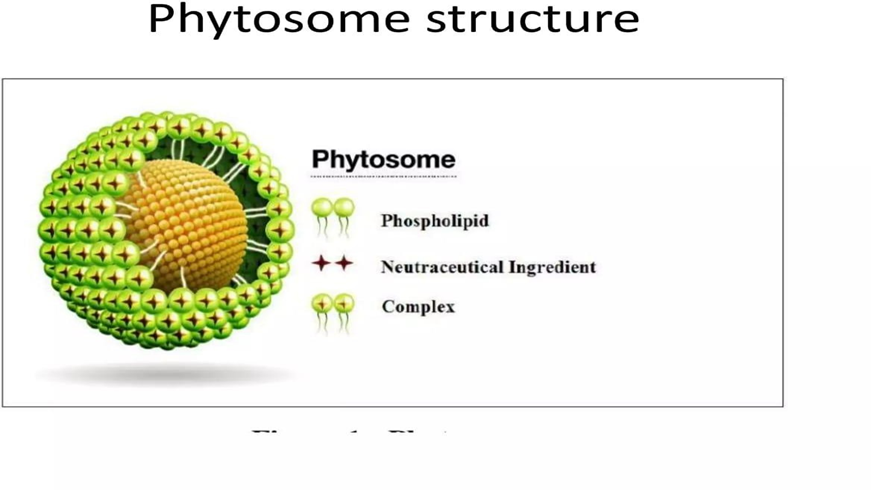
Fig.1- Structure of Phytosome
From ancient times, phyto-chemical and phyto-pharmacological studies have been well established the various creations in natural behavior and their numerous health promising advantages of botanical herbs. Some of the biologically active phyto-constituents are consists in the nature of polar solvents. However, water-soluble phyto-constituents are weakly absorbed when it takes orally or after applied topically. Owing to their big molecular mass and reduced lipid solubility profile it cannot be wrapped by passive distribution. Thus, there are many phyto- constituents which possibly will have various rings system and therefore, they could not be immersed from the intestinal fluid into the blood through basic dispersion course. Also, a small number of phyto-molecules are originated in broke environment which is soluble in lipids along with added oils as well as and it repeatedly show the inhibition to pass the small intestine owing to its dipole characters. The efficiency of every natural product is based on released of complexes. So it resultant shows the lower bioavailability over the herbal drugs.
Physicochemical properties
Phytosomes are the complex between phytoconstituents and natural phospholipid, and the complex is obtained by reacting an appropriate amount of phospholipid and chief constituents in particular solvent.
The interaction between phospholipid and substrate is due to the development of hydrogen bonds between the polar head of phospholipid and the polar functionalities of chief constituents.
On treatment with hydrophilic environment phytosomes shows a cell-like structure like liposomes, but in a liposomes, the chief constituent interacts within the internal pocket while in phytosome the chief active constituents are enveloped the polar head of phospholipid and becoming an integral part of the membrane.
The phytosome is a combination of few molecular complexes which bounded together, while the liposome is a combination of number of phospholipids which react with chief constituent but with.out complete bonding with them.
Biological properties
Phytosomes increases the active absorption of active ingredients and also increases the systematically bioavailability when administered orally.
These are the advance form of the herbal products and having better efficacy as per compare to conventional herbal extract.
Phytosome has better pharmacokinetic as compare to simple herbal drugs.
Structure of Phytosomes
The term "phyto" means plants and "some" means cell-like structure. Phyto-phospholipid complexes are formed by interactions between active constituents and the polar head of phospholipids. Interaction between active constituents and phospholipids permit phospholipid complexes to be an essential part i which the phospholipids head group is attached, but the two long fatty acids chain do not participate in complex formation. The two long chain fatty acids chains can moves and encapsulate the polar part of complexes to form a lipophilic surface. Phyto- phospholipids complexes to form lipophilic surface. Phyto-phospholipids complexes from agglomerates when diluted in water, which resembles a small cell that shows some similarity to liposomes.
Difference between phytosomes and liposomes
Table 1 - Difference between phytosomes and liposomes
|
Sr. No. |
Phytosomes |
Liposomes |
|
1 |
Phytosomes offers more physical stability due to the formation of weak chemical bonds. |
They are lesser stability as compare to phytosomes. |
|
2 |
They are suitable for the dietary supplements. |
They are not suitable for dietary supplements. |
|
3 |
They are preparing in the solvent having low dielectric constant. |
They are prepared in the presence of solvent having high dielectric constant. |
|
4 |
They are more superior to liposome in cosmetic products. |
They are less superior thanphytosomes. |
|
5 |
There is the formation of hydrogen bonds. |
No hydrogen bonds are formed during liposome formation. |
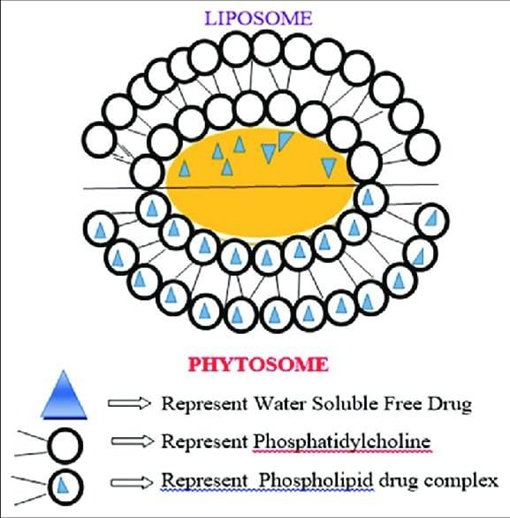
Fig.2 - Difference between Phytosome and Liposome
Advantages of Phytosomes.
Disadvantages of Phytosomes.
General method of preparation
Common stages used in the formulation of phytosomes.
Phospholipids
↓
Dissolved in organic solvent containing drug extract
↓
Solution of phospholipids in organic solvent with drug extract
↓
Drying solvent evaporation
↓
Formation of thin film
↓
Hydration is done
↓
Formation of phytosomal suspension
Methods of preparations of phytosome.
Following are the methods of preparations.
1. Antisolvent precipitation technique.
Drug + Lecithin
↓
Reflux with 20ml Dichloromethane at 60°c for e hrs.
↓
Concentrate mixture to 5-10 ml
↓
Add hexane 20 ml.
↓
Filter the precipitate formed dry crush and pass through # 100
2. Rotary evaporation method.
Drug and Soya lecithin
↓
Dissolved in 30 ml of terahydrofuran
↓
Stirring for 3 hrs at a temperature not excedding 40°c
↓
Thin film is formed
↓
Add n-hexane with stirring
↓
Precipitate obtained
↓
Dry and pass through mesh
↓
Phytosomes are formed
3. Solvent evaporation method.
Solvent evaporation
↓
Drug and Soya Lecithin
↓
Refluxed with 20ml of acetone at a temperature 50°c to 60°c for 2 hrs.
↓
Concentrated mixture to 5-10ml
↓
Obtain the precipitate
↓
Filter and collect the precipitate
↓
Phytosomes are obtained
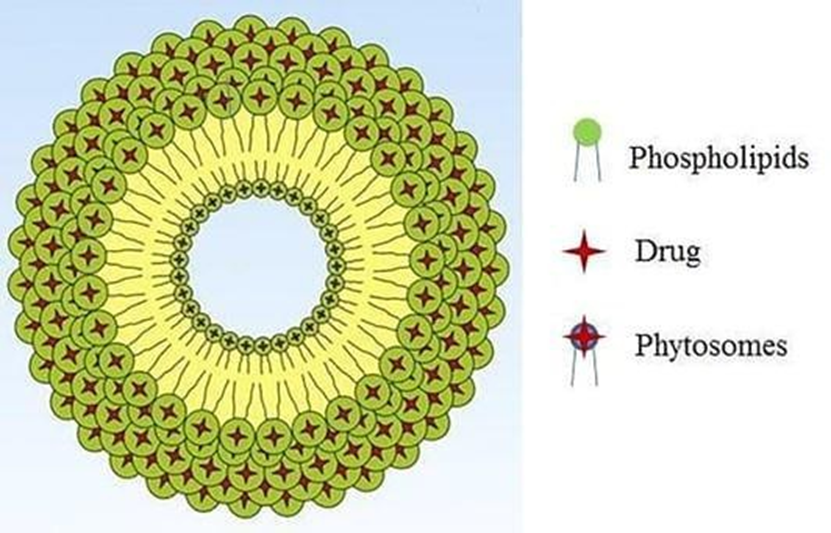
Fig.3- Drug induced Phytosome
Different additives used in the formulation of phytosome.
Analytical aspects of phytosomes.
Various spectroscopic and in-vitro and in-vivo evaluation are applied on phytosomes.
1. Entrapment Efficiency: The entrapment efficiency of a phytosomal formulation can be determined by subjecting the formulation to ultracetrifugation technique. Amount of quercetin in supernatant and sediment gave a total amount of Bombaxceiba in 1 mil dispersion. The percent entrapment was calculated by following formula.
Percent Entrapment =
Amount of Drug in Sediment × 100
Total Amount of Drug Added
2. Transition temperature: The transition temperature of vestibular lipid system can be determination by differential scanning calorimetry.
3. Vesicle size and Zeta potential: The particle size and zeta potential of phytosomes can be determined by dynamic light scattered which uses a computerized inspection system and photon correlation spectroscopy.
4. Surface tension activity measurement: The surface tension activity of drug in aqueous solution can be measured by ring method Du Nouy ring tensiometer.
5. Spectroscopic evaluation: The spectroscopic evaluations are widely employed in order to confirm the formation of complex between phytoconstitutes and the phospholipid moiety interaction between the two.
6. Optical microscopic study: Phytosomes was observed under microscopy, Cippon(Japan). One drop of diluted extract-loaded nanoparticles suspension was deposited on a glass slide and it was. Excess solution was drained off with filter paper and then slide was allowed to dry. The sample was then examined by optical Microscopy.
7. In-vitro drug release study: In-vitro drug release of the sample was carried out using USP-type II dissolution apparatus (Paddle type). The dissolution medium, 900 ml 0.1N HCL was placed into the dissolution flask maintaining the temperature of 37+ or 0.50c and rpm of 50. Equivalent to 100 mg of phytosomes was placed in each bowl of dissolution apparatus.
Formulations
Phytosomes complexes can be formulation both orally and topically.
1. Soft gelatin capsules: Soft gelatin capsules represents ideal solution to formulate phytosome complexes. The complexes are dispersed in oily vehicles to obtain suspension to be filled in soft gelatin capsule. Vegetable or semi-synthetic oil can be used for this purpose,
2. Hard gelatin capsules: Phytosomes complexes can be formulated in hard gelatin capsule as well. A direct volumetric filing processes (without precompression) can be applied. Required amount of powder is can be filled into capsule.
3. Tablets: Whenever direct compression method is applied. Phytosome complex is diluted with 60- 70% of excipients to obtain tablets with appropriate technological and biological characters, Dry granulation method is used for preparation of tablets.
4. Topical dosage form: Topical dosage complexes can be formulated topical as well.
The ideal process to incorporate the phytosome complex in emulsion is to disperse the phospholipid complex in small amount of lipid phase and add it into already created emulsion at low temperature (not higher than 40).
Marketed Preparations of Phytosomes.
Table 2 - Marketed Preparations of Phytosomes.
|
Phytosomes |
Phytoconstituent complexed with pc |
Daily dosage |
Indications |
|
Leucoselect phytosome |
Procyanidolic oligomers (PCOS) from grape seeds |
50-100mg |
Systemic antioxidant, specific. Best choice for most people under age of fifty. Also specific for the eyes, lungs, diabetes, varicose veins, and protection against heart disease. |
|
Greenselect phytosome |
Epigallocatechin 3-0- gallate from camelia sinensis (Green tea) |
50-100mg |
Systemic antioxidant. Best choice for protection against cancer and damage to cholesterol. |
|
Ginkgoselect phytosome |
24% ginkgo flavono glycosides From Ginkgo biloba |
120mg |
Best choice for most people over the age of 50. Protects brain and vascular lining |
|
Silybin phytosome |
Silybin from silymarin (milk thistle) |
120mg |
Best choice if the liver or skin needs additional antioxidant protection. |
|
Siliphos™ milk thistle phytosome |
Silybin from silymarin |
150mg |
Good choice for liver or skin support. |
|
Hawthorn phytosome |
Flavonoids |
100mg |
Best choice in heart disease. |
|
Panax ginseng phytosome |
37.5% ginsenosides from roots of Panax ginseng |
150mg |
As a Food Product. |
|
Glycyrrhiza phytosome |
18-beta glycyrrhetinic acid |
- |
Anti-inflammatory Activity. |
|
Mirtoselect phytosome |
Anthocyanosides from an extract of Bilberry |
- |
These improve capillary tone, reduce abnormal blood vessel permeability & are potent antioxidants. They hold great potential for the management of retinal blood vessel problems and venous insufficiency. |
|
Sabalselect phytosome |
An extract of saw palmet to Berries through supercritical CO? (carbon dioxide) extraction |
- |
It delivers fatty acids, alcohols and sterols that benefit prostate health. Also beneficial for non-cancerous prostate enlargement. |
|
Polinacea TM phytosome |
Echinacosides and a unique high- molecular weight Polysaccharide from Echinacea angustifolia |
- |
It enhances immune function in response to a toxic challenge. |
|
Oleaselect™ phytosome |
Polyphenols from olive oil |
- |
As potent antioxidants, inhibit harmful oxidation of LDL cholesterol, and also have anti-inflammatory activity. |
|
Lymphaselect TM phytosome |
A standardized extract of melilotus officinalis |
- |
Indicated for venous disorders, including chronic venous insufficiency of the lower limbs. |
Applications of Phytosomes.
CONCLUSION
Many plants derived products especially flavonoids and other phenolic compounds are found to have immense therapeutic importance but owing to their polar nature they have low absorption rate which ultimately decreases their therapeutic efficacy. Therefore, such delivery system was desired which can overcome these drawbacks "phytosome" a phytolipid delivery system is a novel approach in this regard. Its commercial scale production is easy. Characterization can easily be done. Percentage entrapment efficacy is high. Many phytosomes are already been made and marketed. Many patents associated with phytosomes are available. Phytosomes have application in pharmaceutical, cosmetics as well as in veterinary field.
REFERENCES





Chaitrali Patil, Shital Pandhare, Harshad Lakade, Srushti Kamble, Trupti Agare, Snehal Durande, Phytosome: Novel Herbal Drug Delivery System, Int. J. of Pharm. Sci., 2025, Vol 3, Issue 12, 3451-3463. https://doi.org/10.5281/zenodo.18033509
 10.5281/zenodo.18033509
