View Article

Abstract

Objective: The aim of the present study was to carried out phytochemical investigation of Hexane, Ethyl acetate, Methanol and Hydroalcoholic extract of Celosia argentea leaves belonging to the family Amaranthaceae. Methods: Celosia argentea leaves extracts was used for plant component analysis. Results: Qualitative phytochemical screening of all extracts of Celosia argentea revealed the presence of different phytochemical constituents like steroids, flavonoids and alkaloids, glycosides, tannins, quinones and carbohydrates. All the extracts of Celosia argentea did not contain the amino acids, oils, saponins. The hexane extract did not contain flavonoids, terpenoids. The percentage of ash content showed that the plant contained 9.234% total ash content, acid insoluble ash content 1.532%, water soluble ash content is 5.845% and Sulphated ash is 0.234%. Water soluble extractive was found 8.452 % and ethanol soluble extractive was 5.67%. The total phenolic contents Celosia argentea extracts were ranging from 12.34 ±0.22 to 32.56±0.32 (mg/g). The hydroalcoholic extract had more phenolic content 32.56±0.32 (mg/g) than other extracts. The alkaloid contents Celosia argentea extracts were ranging from 09.64±0.23to 26.34±0.18 (mg/g). The hydroalcoholic extract had more alkaloid content 28.64 ± 0.12 (mg/g) than other extracts. Conclusion: Thus, it provides evidence that solvent extract of Celosia argentea contains medicinally important bioactive compounds and this justifies the use of plant species as a traditional medicine for treatment of various diseases. All these preliminary reports warrant an in-depth analysis of the usefulness of Celosia argentea as miracle drug against various ailments.

Keywords

Celosia argentea, Phytochemical Screening, Amaranthaceae

Introduction

India has one of the oldest, richest and most diverse cultural traditions associated with the use of medicinal plants. Medicinal plants are great importance to the health of individuals and communities in general. Medicinal plants would be the best source to obtain a variety of newer herbal drugs.1 For centuries plants have provided mankind with useful, sometimes life-saving drugs. Modern pharmaceutical in cases where the correlation between chemical structure and biological activities were noted, emperical science began to give way to rational drug design. This emerging approach to identify and develop potential new drug is largely successful, due to the intellectual cooperation of chemistry (medicinal). Therefore, such plants should be investigated to understand better their properties safety and efficacy. The use of drugs derived from plants has been in practice for a very long time.2 Using plants for the medicinal purpose is an important part of the culture and the medicinal value of plants lies in some chemical substances that produce a definite physiological action on the human body. The most important of these bioactive constituents of plants are alkaloids, tannins, flavonoids and phenolic compounds. Many of the indigenous medicinal plants are used as spices and food plants.3 Herbs being easily available to human beings have been explored to the maximum for their medicinal properties. Different parts of the plants like bark, roots, leaves, exudates, etc. are used as per medicinal properties.4,5 Celosia argentea is an important medicinal plant, found throughout tropical India as a common tree in fields and wasteland.5 Asian origin C. argentea, weed is well known worldwide as edible and ornamental plant belongs to family Amaranthaceae in all the continents with major as Asia and Africa. Plant is commonly known as silver cockscomb, Feather cockscomb. Quail grass, Lagos spinach, Kindayohan, Qing Xiang.6 C. argentea grows as a natural weed throughout the India during rainy season and in the tropical region of the world. C. argentea is an erect, coarse, simple or branched smooth annual tropical herb, 0.5 to 1.5 m tall. Stems are cylindrical and aerial part is branched. Leaves are simple, linear, small, spirally arranged about 5-8 cm by 1-3, alternate and exstipulate. The blade is lanceolate and ovate. The apex is acuminate. It has pinkish or white flower in dense erect spikes, 3-20 cm long, 1.5-2 cm thick. The fruits are globose and seeds are shining black, 1-1.5 mm diameter. Among the different plants of Celosia species verity C. argentea is known for its very brilliant colors and have high nutritional as well as medicinal values for traditional uses.7

MATERIALS AND METHODS

Collection of Plant Materials: C. argentea leaves were collected from the local area of Jaiesamand region of Rajasthan, India. The leaves were washed under running tap water to eliminate dust and other foreign particles and to cleanse the leaves thoroughly and dried.

Preparation of plant extract: The plant material was washed and then kept for shade drying for 7 days. The dried plant sample was powdered by mechanical grinder into a fine powder. The air-dried powdered material of the plant was extracted with Hexane, Ethyl Acetate, Methanol and Hydroalcoholic solvent [Ethanol and Water solvent (60:40)] using the Soxhlation process with the help of a Soxhlet apparatus. Excess solvent was then evaporated in a water bath at 50-100°C to obtain the crude extract and stored in airtight containers.8  

Phytochemical Screening

Preliminary Phytochemical Screening: Chemical tests for the screening and identification of bioactive chemical constituents like alkaloids, carbohydrates, glycosides, saponins, phenolic compounds, phytosterols, proteins, amino acids, flavonoids, and tannins, in the medicinal plants under study were carried out in extracts by using the standard procedure.9

Determination of Physiochemical Characters

  1. Ash analysis: Qualities of herbal medicines are based on three important such as identity, purity and assay of plant material. The correct identity of the crude herbal material is the prime importance in set up the quality control of herbal drug. It is obvious that the content is the most difficult one to assess, since in most herbal drug the active constituent is unknown. Sometimes markers can be used which are, by definition chemically defined constituent that are of interest for control purpose.10
  1. Total Ash: Total Ash -Weigh exactly 2 g of C. argentea powder sample and take it in clean and cooled previously weighed crucible. Ignite with Bunsen burner for an hour till it becomes a red hot. Complete the incineration in muffle furnace at 550±20 ºC till gets grey ash. Allow cooling naturally then transferring to desiccator and note the weight of ash. Again, heat the crucible, cool and note the weight of ash. Continue till gets constant weight of ash. Calculate the percentage of total ash.
  1.  Water soluble Ash: Dissolve the total ash in 25 ml Millipore water, boiled for 10 minutes. Cool and filter through Whatman filter paper and collect residue. Wash residue multiple time using hot water. Calculate weight of water-soluble ash by subtracting weight of residue from total ash and percentage of water-soluble ash.

Water Soluble Ash = Total Ash – Water Insoluble Ash (W3)

  1. Acid insoluble ash: Weigh exactly 2 g of powder sample of C. argentea powder in pre weighed crucible. Ignite for 1 hr on Bunsen burner. Keep it in furnace at 550±20 ºC till grey color is formed and moist grey ash with con. HCl and evaporate to dryness in an oven at 135±2 ºC for 3 hrs. Cool and add 25 ml of dilute HCl and heat it on water bath for 10 minutes. Cool and filter through Whatman 41 filter paper. Wash ash with hot water till all the chloride gets removed by taking test with silver nitrate solution. Cool, dry and ignite residue in muffle furnace at 550±20 ºC for an hrs. Cool in desiccators and note the weight of acid insoluble ash and % acid insoluble ash.

W1=Weight of sample taken,

W2= Weight of empty crucible,

W3 = (Weight of crucible + Acid insoluble Ash).

  1. Sulphated ash: A platinum/silica crucible was heated to redness for 10 min, allowed to cool in a desiccator, and weighed. Accurately weighed 1-2 g of the plant material was put into the crucible, gently ignited at first, until the substance was thoroughly charred. The residue was cooled, moistened with 1 mL of H2SO4, heated gently until white fumes were no longer evolving, and ignited at 800°C ± 25°C until all black particles disappeared. The ignition was conducted in a place protected from air currents. The crucible was allowed to cool; a few drops of H2SO4 were added and the crucible was heated. Then it was ignited as before, allowed to cool, and weighed. The operation was repeated until two successive weighing did not differ by more than 0.5 mg.
  1. Moisture content: 10 g of plant material was placed (without preliminary drying) after accurately weighing it in a tarred evaporated dish. This was dried at 105? C for 5 h and weighed. Drying and weighing was continued at 1 h interval until we got the constant weight. Constant weight was reached when two consecutive weights, after drying for 30 min. and cooling for 30 min. in a desiccator, showed not more than 0.1 g difference.11
  2. Alcohol soluble: An accurately weighed 5g of coarsely powdered air-dried drug was macerated in 100mL of ethanol in a closed flask for 24h, shaking frequently during 6h and allowed to stand for 18h. It was filtered rapidly taking precautions against loss of solvent. 25mL of the filtrate was evaporated to dryness in a tarred flat-bottomed shallow dish and dried at 105?C to constant weight. The alcohol soluble extractive with reference to the air-dried drug was calculated.
  3. Determination of Extractive values: The amount of extractable matter defines the quantity of phytoconstituents extracted with solvent from the medicinal plant in the form of powder. As per herbal Indian pharmacopeia ethanol and water are the most common solvents to determine the extractable matter. Extractives of herbal medicines are key role for quality as well as purity of herbal medicines and to know active phytoconstituents from medicinal plants.12
  1. Water Soluble Extractives: Exactly 5 g of C. argentea powder sample was transferred to 150 ml round bottom extraction flask, pour 100 ml Millipore water. Shake for 6 hrs on vortex machine. Filter in iodometric flask through Whatman paper No. 42, where flask as well paper was previously weighed, concentrate it on rotavapor and evaporates to dryness on water bath. Dry the residue at 105 ºC for six hrs., cool in desiccator. Note the weight of flask with Whatman paper; find weight of extractives, hence percentage of water-soluble extractives.
  2. Ethanol Soluble Extractives: Exactly 5 g of C. argentea powder sample was transferred to 150 ml round bottom extraction flask, pour 100 ml absolute alcohol. Shake for 6 hrs on vortex machine. Filter in Erlenmeyer flask through Whatman paper, where flask as well paper is previously weighed, concentrate it on rotavapor and evaporates to dryness on water bath. Dry the residue at 37 ºC for six hrs., cool in desiccator. Note the weight of flask with Whatman paper No. 42; find weight of extractives, hence percentage of ethanol soluble extractives.
  3. Petroleum ether soluble extractive value: An accurately weighed 5g of coarsely powdered air-dried drug was macerated in 100mL of petroleum ether in a closed flask for 24h, shaking frequently during 6h and allowed to stand for 18h. It was filtered rapidly taking precautions against loss of solvent. 25mL of the filtrate was evaporated to dryness in a tarred flat-bottomed shallow dish and dried at 105?C to constant weight. The percentage of the petroleum ether soluble extractive with reference to the air-dried drug was calculated.
  4. Determination of Chloroform Soluble Extractives: The procedure followed for the determination of alcohol soluble extractive value was adopted for the determination of chloroform soluble extractive, ethyl acetate soluble extractive, and benzene soluble extractive. Instead of ethanol respective solvents were used for the determination of their extractive values. The percentage of chloroform soluble extractives were calculated

Quantitative Estimation Total Phenolic and Alkaloid Content

Estimation of Total Phenolic Content13

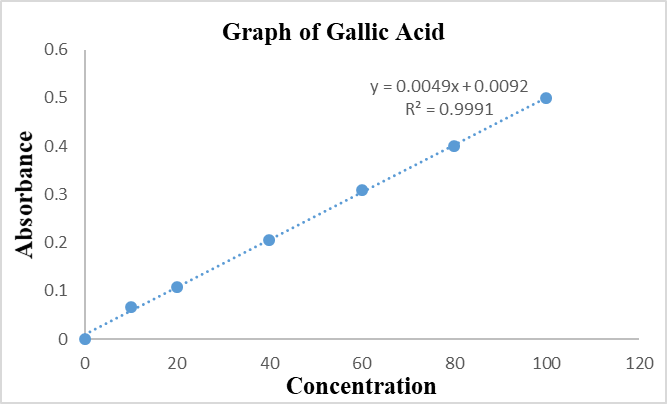
Total phenolic content was determined using the Folin-Ciocalteau reagent. Folin-Ciocalteau colourimetry is based on a chemical reduction of the reagent, a mixture of tungsten and molybdenum oxides. The products of the metal oxide reduction have a blue absorption with a maximum at 725 nm. The intensity of the light absorption at that wave length is proportional to the concentration of phenols. By using standard Gallic acid calibration curve, measure the concentration of phenolic content in Gallic acid total equivalents using units mg/g. (GAE).

Preparation of standard: Standard solution of Gallic acid was prepared by adding 10 mg of accurately weighed Gallic acid in 10 ml of distilled water.

Preparation of sample: weighed 10 mg of all extracts of Celosia argentea and then dissolved in the respective extracts were dissolved in 10 ml methanol and used for the estimation.

Procedure: The total phenolic content of the extracts of Celosia argentea was determined by Folin- Ciocalteau assay method. To an aliquot 100μl of extracts of Celosia argentea (1mg/ml) or standard solution of Gallic acid (10, 20, 40, 60, 80, 100 μg/ml) added 50μl of Folin-ciocalteau reagent followed by 860μl of distilled water and the mixture was incubated for 5min at room temperature. 100μl of 20% sodium carbonate and 890μl of distilled water were added to make the final solution to 2ml. It was incubated for 30 min in dark to complete the reaction after that absorbance of the mixture was measured at 725 nm against blank. Distilled water was used as reagent blank. The tests were performed in triplicate to get the mean values. The total phenolic content was found out from the calibration curve of Gallic acid, and it was expressed as milligrams of Gallic Acid Equivalents (GAE) per gram of extract

Estimation of Alkaloid Content

The plant extracts (1 mg/ml) were dissolved in 2 N HCl and then filtered. The pH of phosphate buffer solution was adjusted to neutral with 0.1 N NaOH. One ml of this solution was transferred to a separating funnel and then 5 ml of BCG solution along with 5 ml of phosphate buffer were added. The mixture was shaken and the complex formed was fractioned with chloroform by vigorous shaking. The fractions were collected in a 10 ml volumetric flask and diluted to volume with chloroform. The absorbance of the complex in chloroform was measured at 470 nm. All experiments were performed thrice; the results were averaged and reported in the form of Mean ± S.E.M.

RESULTS AND DISCUSSION

Percentage of yield extract: The % yields of all solvent extracts were mention in Table 1.

Table 1: Percent Yield of Celosia Argentea Extracts

S. No.

Type of Extract

% Yield obtained (w/w)

1

Hexane

14.22

2

Ethyl acetate

25.10

3

Methanol

32.01

4

Hydroalcoholic

40.02

Phytochemical screening

Preliminary Phytochemical Screening: Qualitative phytochemical screening of all fractions of Celosia argentea revealed the presence of different phytochemical constituents like steroids, flavonoids and alkaloids, glycosides, tannins, quinones and carbohydrates. All the extracts of Celosia argentea did not contain the amino acids, oils, saponins. The hexane extract did not contain flavonoids, terpenoids. Results of qualitative phytochemical screening were shown in Table 2. (+ Present., - Absent.).

Table 2: Preliminary Phytochemical Screening of Celosia argentea Extracts

Phytochemical

Hexane

Ethyl acetate

Methanol

Hydroalcoholic

Alkaloids

+

+

+

+

Glycosides

+

+

+

+

Flavonoids

-

+

+

+

Tannins

+

+

+

+

Amino acid

-

-

-

-

Oils

-

-

-

-

Phytosterols

+

+

+

+

Terpenoids

-

+

+

+

Carbohydrates

-

+

+

+

Lipids

-

-

+

+

Phenol and Phenolic compounds

+

+

+

+

Saponins

-

+

+

_

Physical Characterization Of Extract

Result obtained were expressed in percentage of ash content showed that the plant contained 9.234% total ash content, acid insoluble ash content 1.532%, water soluble ash content was 5.845% and Sulphated ash was 0.234%. Ash is inorganic residue in the form of oxides, sulphates, phosphates, chlorides and silicates remaining after either ignition or complete oxidation of organic compounds by burning the plant, which represent certain minerals in C. argentea important of nutritional value for diet as a leafy vegetable.

Table 3: Physiochemical Characterization of Celosia argentea

Sr. No.

Properties

Observations %

01

Total ash value

9.234

02

Acid insoluble ash

1.532

03

Water soluble ash

5.845

04

Sulphated ash

0.234

05

Moisture content

0.01

06

Alcohol soluble

5.23

Extractive values: Less value of extractives indicated addition of exhausted material, adulterations or it may be due to non-proper drying or storage of plant material.

Table 4: Extractive of Celosia argentea leaves

Sr. No.

Extractive Value

Observations %

01

Water Soluble Extractives

8.452

02

Ethanol Soluble Extractives

5.67

03

Petroleum ether soluble extractive value

1.233

04

Chloroform soluble extractives

2.298

Water soluble extractive was found 8.452 % and ethanol soluble extractive was 5.67%. Higher percentage of water-soluble extractives represent that more phytochemicals will get extracted in water as compared to ethanol helps for formulation of herbal drug.

Quantitative Estimation Total Phenolic and Alkaloid Content

Estimation Total Phenolic Content

Table 5: Absorbance Values of Gallic acid

Sample

Concentration (μg/ml)

Absorbance


Standard

(Gallic acid) 1mg/ml

10

0.067

20

0.108

40

0.205

60

0.309

80

0.401

100

0.499

Graph 7.1: Standard Graph Of Gallic Acid For Total Phenolic Content

Table 6 Estimation of Total Phenolic Content

Sr No.

Name of extract

Total Phenolic Content

1

Hexane

12.34 ±0.22

2

Ethyl acetate

19.23±0.1

3

Methanol

23.89±0.12

4

Hydroalcoholic

32.56±0.32

The total phenolic contents Celosia argentea extracts were ranging from 12.34 ±0.22 to 32.56±0.32 (mg/g). The hydroalcoholic extract had more phenolic content 32.56±0.32 (mg/g) than other extracts

Estimation of Total Alkaloid Content

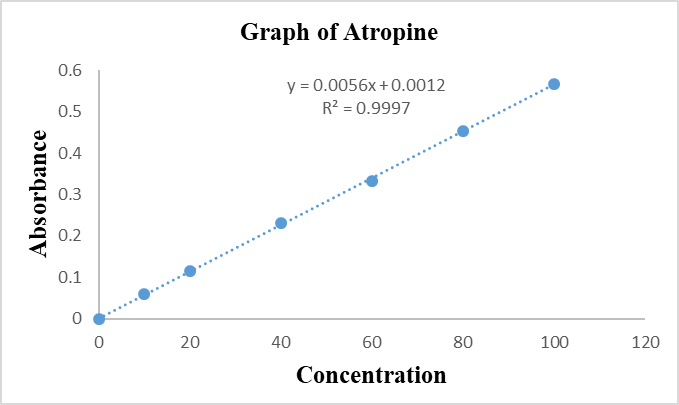
Table 7: Absorbance Values of Atropine

Sample

Concentration (μg/ml)

Absorbance


Standard

(Atropine) 1mg/ml

10

0.059

20

0.115

40

0.231

60

0.332

80

0.454

100

0.568

Graph 2: Standard Graph of Atropine for Total alkaloid content

Table 8: Estimation of Total Alkaloid Content

Sr No.

Name of extract

Alkaloid Content

1

Hexane

09.64±0.23

2

Ethyl acetate

19.23±0.23

3

Methanol

29.12 ±0.23

4

Hydroalcoholic

28.64 ± 0.12

The alkaloid contents Celosia argentea extracts were ranging from 09.64±0.23to 26.34±0.18 (mg/g). The hydroalcoholic extract had more alkaloid content 28.64 ± 0.12 (mg/g) than other extracts.

CONCLUSION

The plant screened for phytochemical constituents seemed to have the potential to act as a source of useful drugs and also to improve the health status of the consumers as a result of the presence of various compounds that are vital for good health. These preliminary reports warrant an in-depth analysis of the usefulness of Celosia argentea as miracle drug against various ailments.

REFERENCES
  1. Okwu DE. Flavoring properties of spices on cassava fufu. Afr J Root Tuber Crops 1999; 3:19-21.
  2. Okwu DE. Evaluation of the chemical composition of indigenous spices and flavouring agents Global. J Pure Appl Sci 2001; 5:7455-9.
  3. Hill AF. Economic botany a textbook of useful plants and plant products’’. 2nd edition McGraw-Hill Book Company. Inc. New York; 1952.
  4. Perumal samy R, Gopala Krishnakone P. Current status of herbal and their future perspectives, nature precedings; 2007.
  5. Krishnamurthi A. The wealth of India, “A publication and information directorate’’. New-Delhi: Council of Scientific and Industrial Research; 2003; 4:92.
  6. Gilani, A. H. (2005). Trends in ethnopharmacology. Journal of ethnopharmacology, 100(1-2), 43-49.
  7. Misra, S., & Misra, M. K. (2014). Nutritional evaluation of some leafy vegetable used by the tribal and rural people of south Odisha, India. Journal of Natural Product and Plant Resources, 4(1), 23-28.
  8. Kamboj, A. (2012). Analytical evaluation of herbal drugs. Drug discovery research in pharmacognosy, 3, 23-55.
  9. Khandelwal, K. (2008). Practical pharmacognosy. Pragati Books Pvt. Ltd.
  10. Kamboj, A. (2012). Analytical evaluation of herbal drugs. Drug discovery research in pharmacognosy, 3, 23-55.
  11. Mushtaq, A., Akbar, S., Zargar, M. A., Wali, A. F., Malik, A. H., Dar, M. Y., ... & Ganai, B. A. (2014). Phytochemical screening, physicochemical properties, acute toxicity testing and screening of hypoglycaemic activity of extracts of Eremurus himalaicus baker in normoglycaemic Wistar strain albino rats. BioMed research international, 2014(1), 867547. DOI: 10.1155/2014/867547
  12. Reino, J. L., Guerrero, R. F., Hernandez-Galan, R., & Collado, I. G. (2008). Secondary metabolites from species of the biocontrol agent Trichoderma. Phytochemistry Reviews, 7, 89-123.
  13. Lakshmi KS, Sangeetha D, Sivamani S et al. In vitro antibacterial, antioxidant, haemolytic, thrombolytic activities and phytochemical analysis of Simarouba glauca leaves extracts. International Journal of Pharmaceutical Sciences and Research. 2014; 5(2): 432.
  14. Prajapati, N. D., Purohit, S. S., Sharma, A. K., & Kumar, T. (2003). A handbook of medicinal plants: A complete source book. In A handbook of medicinal plants: a complete source book (pp. 554-554).
  15. Vetrichelvan, T., Jegadeesan, M., & Devi, B. A. U. (2002). Anti-diabetic activity of alcoholic extract of Celosia argentea L INN. seeds in rats. Biological and pharmaceutical bulletin, 25(4), 526-528.
  16. Hase, K., Kadota, S., Basnet, P., Namba, T., & Takahashi, T. (1996). Hepatoprotective effects of traditional medicines. Isolation of the active constituent from seeds of Celosia argentea. Phytotherapy Research, 10(5), 387-392.
  17. Sunday, O. A., Munir, A. B., Akeeb, O. O., Bolanle, A. A., & Badaru, S. O. (2010). Antiviral effect of Hibiscus sabdariffa and Celosia argentea on measles virus.
  18. Malomo, S. O., Ore, A., & Yakubu, M. T. (2011). In vitro and in vivo antioxidant activities of the aqueous extract of Celosia argentea leaves. Indian journal of pharmacology, 43(3), 278-285.
  19. Cai, Y., Sun, M., & Corke, H. (2003). Antioxidant activity of betalains from plants of the Amaranthaceae. Journal of agricultural and food chemistry, 51(8), 2288-2294.
  20. Tang, Y., Xin, H. L., & Guo, M. L. (2016). Review on research of the phytochemistry and pharmacological activities of Celosia argentea. Revista brasileira de farmacognosia, 26, 787-796.DOI: 10.1016/j.bjp.2016.06.001.

Reference

  1. Okwu DE. Flavoring properties of spices on cassava fufu. Afr J Root Tuber Crops 1999; 3:19-21.
  2. Okwu DE. Evaluation of the chemical composition of indigenous spices and flavouring agents Global. J Pure Appl Sci 2001; 5:7455-9.
  3. Hill AF. Economic botany a textbook of useful plants and plant products’’. 2nd edition McGraw-Hill Book Company. Inc. New York; 1952.
  4. Perumal samy R, Gopala Krishnakone P. Current status of herbal and their future perspectives, nature precedings; 2007.
  5. Krishnamurthi A. The wealth of India, “A publication and information directorate’’. New-Delhi: Council of Scientific and Industrial Research; 2003; 4:92.
  6. Gilani, A. H. (2005). Trends in ethnopharmacology. Journal of ethnopharmacology, 100(1-2), 43-49.
  7. Misra, S., & Misra, M. K. (2014). Nutritional evaluation of some leafy vegetable used by the tribal and rural people of south Odisha, India. Journal of Natural Product and Plant Resources, 4(1), 23-28.
  8. Kamboj, A. (2012). Analytical evaluation of herbal drugs. Drug discovery research in pharmacognosy, 3, 23-55.
  9. Khandelwal, K. (2008). Practical pharmacognosy. Pragati Books Pvt. Ltd.
  10. Kamboj, A. (2012). Analytical evaluation of herbal drugs. Drug discovery research in pharmacognosy, 3, 23-55.
  11. Mushtaq, A., Akbar, S., Zargar, M. A., Wali, A. F., Malik, A. H., Dar, M. Y., ... & Ganai, B. A. (2014). Phytochemical screening, physicochemical properties, acute toxicity testing and screening of hypoglycaemic activity of extracts of Eremurus himalaicus baker in normoglycaemic Wistar strain albino rats. BioMed research international, 2014(1), 867547. DOI: 10.1155/2014/867547
  12. Reino, J. L., Guerrero, R. F., Hernandez-Galan, R., & Collado, I. G. (2008). Secondary metabolites from species of the biocontrol agent Trichoderma. Phytochemistry Reviews, 7, 89-123.
  13. Lakshmi KS, Sangeetha D, Sivamani S et al. In vitro antibacterial, antioxidant, haemolytic, thrombolytic activities and phytochemical analysis of Simarouba glauca leaves extracts. International Journal of Pharmaceutical Sciences and Research. 2014; 5(2): 432.
  14. Prajapati, N. D., Purohit, S. S., Sharma, A. K., & Kumar, T. (2003). A handbook of medicinal plants: A complete source book. In A handbook of medicinal plants: a complete source book (pp. 554-554).
  15. Vetrichelvan, T., Jegadeesan, M., & Devi, B. A. U. (2002). Anti-diabetic activity of alcoholic extract of Celosia argentea L INN. seeds in rats. Biological and pharmaceutical bulletin, 25(4), 526-528.
  16. Hase, K., Kadota, S., Basnet, P., Namba, T., & Takahashi, T. (1996). Hepatoprotective effects of traditional medicines. Isolation of the active constituent from seeds of Celosia argentea. Phytotherapy Research, 10(5), 387-392.
  17. Sunday, O. A., Munir, A. B., Akeeb, O. O., Bolanle, A. A., & Badaru, S. O. (2010). Antiviral effect of Hibiscus sabdariffa and Celosia argentea on measles virus.
  18. Malomo, S. O., Ore, A., & Yakubu, M. T. (2011). In vitro and in vivo antioxidant activities of the aqueous extract of Celosia argentea leaves. Indian journal of pharmacology, 43(3), 278-285.
  19. Cai, Y., Sun, M., & Corke, H. (2003). Antioxidant activity of betalains from plants of the Amaranthaceae. Journal of agricultural and food chemistry, 51(8), 2288-2294.
  20. Tang, Y., Xin, H. L., & Guo, M. L. (2016). Review on research of the phytochemistry and pharmacological activities of Celosia argentea. Revista brasileira de farmacognosia, 26, 787-796.DOI: 10.1016/j.bjp.2016.06.001.

Photo
Kapil Dev Pandey
Corresponding author

Lords University, Alwar, Rajasthan

Photo
Dr. Naresh Kalra
Co-author

Lords University, Alwar, Rajasthan

Photo
Dr. Abhay Gupta
Co-author

Lords University, Alwar, Rajasthan

Kapil Dev Pandey*, Dr. Naresh Kalra, Dr. Abhay Gupta, Phytochemical Investigation of Celosia Argentea Leaves Extracts, Int. J. of Pharm. Sci., 2025, Vol 3, Issue 12, 539-547. https://doi.org/10.5281/zenodo.17803180

More related articles
Overview of Bioactive Phytochemicals in Withania s...
Praveen Raja S, Sri Dharshan K, Kalaivani D, Keerthana M, ...
Artificial Intelligence in Phytochemical Screening...
Mayuri Mohondkar , Shivprasad Dhage, Dr. Sonali Uppalwar, ...
Amorphophallus paeoniifolius: An Omnidimensional R...
Karunakar Hegde, Anvitha D K, Meghana Bharadhwaj J, Supriya T L, ...
Related Articles
A Comprehensive Review of Anticancer Phytochemicals: Mechanisms, Efficacy and Th...
Tejas Hulge , Barkade Sumit Dattatray, Markad Prashant Santosh, Komal Salunkhe, Dr. R.R. Bendgude, ...
Phytochemical and Pharmacological Insights into Croton tiglium Linn: A Promising...
Ankita Lokare, Madhura Khot, Saniya Shaikh, V. Mote , ...
Overview of Bioactive Phytochemicals in Withania somnifera Relieving Stress and ...
Praveen Raja S, Sri Dharshan K, Kalaivani D, Keerthana M, ...
More related articles
Overview of Bioactive Phytochemicals in Withania somnifera Relieving Stress and ...
Praveen Raja S, Sri Dharshan K, Kalaivani D, Keerthana M, ...
Artificial Intelligence in Phytochemical Screening: Emerging Trends and Future D...
Mayuri Mohondkar , Shivprasad Dhage, Dr. Sonali Uppalwar, ...
Amorphophallus paeoniifolius: An Omnidimensional Review Covering Botanical Descr...
Karunakar Hegde, Anvitha D K, Meghana Bharadhwaj J, Supriya T L, Thamsheera, Trupti Shanmukh Naik, ...
Overview of Bioactive Phytochemicals in Withania somnifera Relieving Stress and ...
Praveen Raja S, Sri Dharshan K, Kalaivani D, Keerthana M, ...
Artificial Intelligence in Phytochemical Screening: Emerging Trends and Future D...
Mayuri Mohondkar , Shivprasad Dhage, Dr. Sonali Uppalwar, ...
Amorphophallus paeoniifolius: An Omnidimensional Review Covering Botanical Descr...
Karunakar Hegde, Anvitha D K, Meghana Bharadhwaj J, Supriya T L, Thamsheera, Trupti Shanmukh Naik, ...