
1,2 Department of Chemistry, FME department Audisankara Deemed to be University, Gudur-542101-A.P, India.
3 Department of Physics, Annamalai University, Tamil Nadu-India.
4 Department of Chemistry, Annamalai University, Tamil Nadu, India.
5 Department of Education, Kashmir University, J and K-India.
6 Department of Botany, Annamalai University, Tamil Nadu- India.
Many people think of chemistry as a field limited to labs, test tubes, and complicated equations. However, beneath the surface of our everyday activities is a massive network of unseen chemical reactions that influence technology, the environment, and our health. This chapter examines the invisible chemistry that underlies commonplace occurrences, such as food oxidation, photochemical reactions that cause textiles to lose their color, metabolic changes that support life, and the polymerization processes behind contemporary materials. This work demonstrates how invisible processes connect the tiny and macroscopic worlds by deciphering the molecular mechanics underlying common activities like cooking, cleaning, breathing, and even emotions. The chapter focuses on green and sustainable chemistry methods that reduce dangerous reactions in both home and commercial environments. "Invisible Reactions: The Hidden Chemistry of Everyday Life" encourages readers to view chemistry as an intimate, ongoing process that determines the essence of daily life rather than as a distant science through captivating examples and scientific discoveries.
Every day, we traverse a terrain of unseen chemical reactions. Bread browns in an oven, a coin greens and flakes, clothes lose stains in washing machines, and our smartphones store energy in tiny cells, all driven by chemical transformations that are, at first glance, unremarkable. This chapter peels back that everyday curtain. It explains the mechanisms behind collective household and environmental phenomena, suggests simple demonstrations readers can do safely, and highlights new perspectives and research directions that make
"Everyday Chemistry" an active area of study rather than just a set of disconnected curiosities.
“Invisible reactions” are chemical processes that are either:
Understanding these processes matters for health (indoor air quality), sustainability (battery recycling, green cleaning), and innovation (smart materials, sensors).
1. Food chemistry at home (The Maillard reaction and lipid chemistry)
1.1 The Maillard reaction (browned food tastes different)
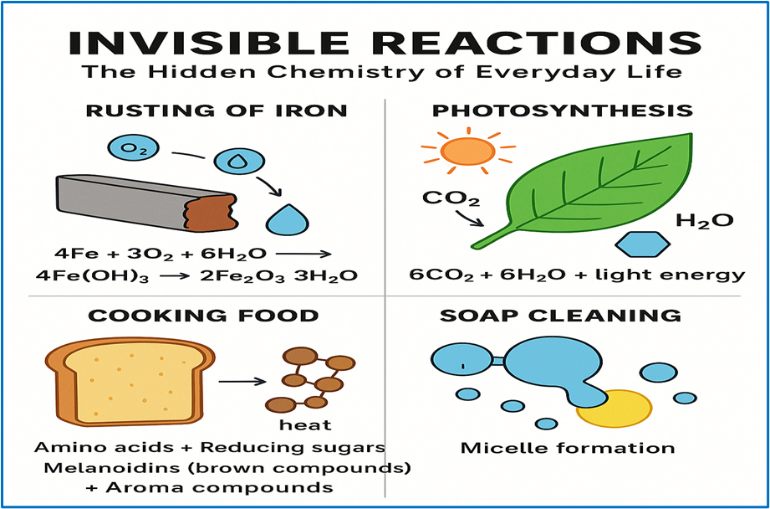
When you roast an onion or sear meat, you invoke the Maillard reaction: a complex network of non-enzymatic reactions between reducing sugars and amino groups that produce browning, aroma compounds, and flavor complexity. The early step forms Amadori (and related) rearrangement products; subsequent fragmentation, Strecker degradations, and polymerizations produce melanoidins and volatile flavor molecules. The reaction depends strongly on temperature, moisture, pH, and the reactant identities which is why dry, high-heat searing yields different aromas from slow braising. Recent syntheses and reviews summarize mechanistic steps and the balance of beneficial flavor vs. formation of potentially harmful advanced glycation end products (AGEs).
1.2 Lipid oxidation (Rancidity and Nutrition)
Unsaturated lipids in oils oxidize via radical chain reactions. Initiation (by heat, light, metal catalysts) produces lipid radicals; propagation leads to peroxides and volatile aldehydes responsible for "off" flavors. Antioxidants (BHT, tocopherols, rosemary extracts) interrupt propagation. Minimizing exposure to light, oxygen, and metal traces preserves oil quality.
2. Surfactants and cleaning (Soap make things “Invisible”)
2.1 Surfactant structure and micelle formation
Soaps and detergents are amphiphiles: a hydrophilic head and a hydrophobic tail. Above the critical micelle concentration (CMC), they aggregate into micelles that solubilize nonpolar soils in water. Cleaning kinetics and adsorption at surfaces are influenced by monomer micelle exchange, which is a dynamic equilibrium in micelle generation. Modern surfactant science explores bio surfactants and greener formulations with lower environmental persistence.
3. Corrosion (Everyday electrochemistry)
3.1 The basics of electrochemical corrosion
Corrosion is an electrochemical process: spatially separated anodic oxidation of metal (e.g., Fe → Fe²? + 2e?) and cathodic reduction (often O? + 2H?O + 4e? → 4OH? in neutral/alkaline water). Micro-environment differences (oxygen concentration, pH, galvanic contacts) create local cells that drive metal loss.
In common terms: Moisture + Electrolyte (salt) + Oxygen + Metal geometry = Corrosion. Reviews of electrochemical mechanisms and mitigation approaches are comprehensive and practical for engineers and scientists.
3.2 Prevention and common examples
4. Energy storage in your pocket: battery chemistry
4.1 Lithium-ion battery fundamentals
Rechargeable batteries in portable electronics operate via reversible redox chemistry and ion shuttling between electrodes. In Li-ion cells, lithium cations intercalate into cathode and anode host structures during charging/discharging; electrolyte and solid electrolyte interphase (SEI) layers critically influence stability, life, and safety. Advances in cathode materials (layered oxides, olivines), electrolyte formulations, and interface engineering have driven the remarkable performance improvements of lithium-ion technology. However, resource supply chains and environmental impacts (mining of Li/Co/Ni) are active areas of concern.
4.2 Everyday implications
5. Bio-chemistry and fermentation
5.1. Fermentations by bacteria and yeast
Under anaerobic or low-oxygen circumstances, microbes use the fermentation pathway to transform carbohydrates into ethanol, organic acids, gases, or other compounds. Through the processes of glycolysis and decarboxylation, glucose is converted into ethanol and CO? during traditional yeast-mediated alcoholic fermentation. Fermentation imparts flavors and preserves food while forming value-added co-products (e.g., organic acids, volatile esters). In order to get larger yields and customized flavor profiles, modern biotechnology optimizes strains and methods.
6. VOCs and indoor chemistry {Air (which we cannot see)}
6.1 Organic substances that are volatile (VOCs)
VOCs are released by a variety of household goods, including paints, cleaning supplies, air fresheners, and personal care items.Even human occupants emit VOCs (breath, skin). VOCs can react indoors (with ozone or radicals) to produce secondary pollutants, irritants, and ultrafine particles. Prolonged exposure to certain VOCs has been linked to respiratory and neurological effects; monitoring and ventilation are practical mitigations.
6.2 Photochemistry and urban smog (Indoors and, outside)
In the troposphere, sunlight drives reactions between NOx and VOCs that form ozone and secondary organic aerosols. The same classes of chemistry operate indoors where oxidants (ozone, OH) are present, sometimes generated by devices or infiltration — producing less visible but potentially harmful products. Understanding sensitivity to precursor ratios (NOx vs VOC load) is key to mitigation strategies.
7. Photochemistry (Sunscreens and photostability)
Several sunscreen active ingredients absorb UV and dissipate energy either harmlessly (as heat) or by generating reactive species. Photostability, skin penetration, and environmental effects (e.g., coral reef exposure) are active research areas. When choosing photoprotective formulations, consider broad-spectrum coverage and photostable combinations rather than single filters.
8. Polymers, adhesives and materials (Aging and, Invisible degradation)
Plastics and polymers undergo chemical changes over time with chain scission, crosslinking, oxidation, and hydrolysis that alter mechanical properties. Environmental stressors (UV light, heat, oxygen) accelerate degradation. Understanding these invisible chemical changes informs material choice for packaging, textiles, and household goods, and guides circular-economy design for repair and recycling
9. Simple, safe experiments and demonstrations (classrooms or outreach)
Maillard browning demo: Roast small pieces of bread under different temperatures and moistures; compare color and aroma (safety: avoid burning)
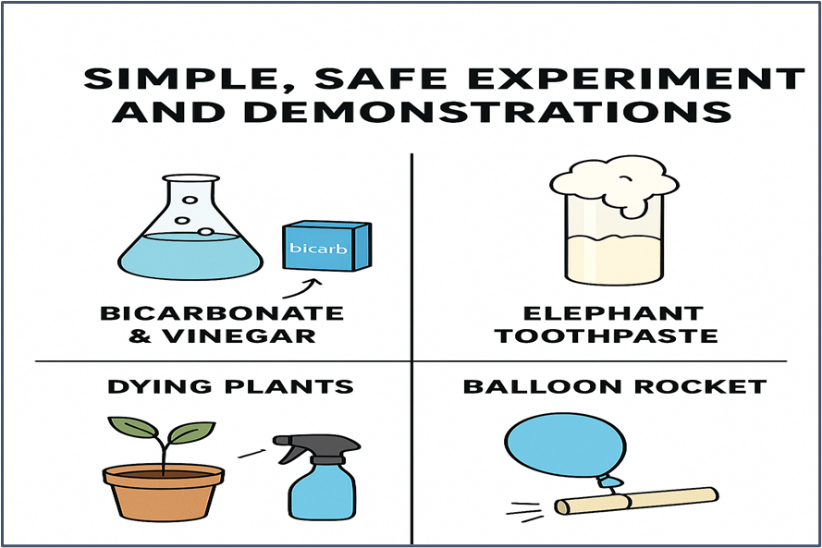
Visualize a micelle by mixing water and oil, then adding dish soap and watching for emulsification. By diluting detergent and monitoring opacity changes, one can approximate CMC.
Demo of a corrosion cell: To demonstrate galvanic effects, place an iron nail and a copper sheet separately in a saline solution and link them. Use low voltages and watch for rusting; be careful while handling salts and metals and dispose of them properly.
CO? capture during fermentation: CO? is produced during small-scale dough fermentation in a sealed bag using a pressure balloon.
Qualitative indoor VOC experiment: Prioritize safety and avoid using harmful chemicals by comparing the persistence of odors after using various cleansers and ventilation rates.
10. Novelty (new viewpoints and lines of inquiry)
Three new contributions are made in this chapter:
Applying systems thinking to domestic chemistry:
Consider commonplace processes as a coupled network with shared drivers (oxidative stressors: light, heat, metal catalysts; reaction sinks: ventilation, sorption to surfaces) rather than treating individual "invisible" reactions as distinct (e.g., rust, Maillard, VOC emissions). Opportunities for combined mitigation techniques, such as material selections that lower both VOC emissions and propensity to promote oxidation, are made possible by this network approach.
Mapping "hidden reaction networks" in built environments:
I propose systematic mapping projects that pair low-cost sensors (VOCs, CO?, and ozone), targeted surface swabs, and simple electrochemical probes to correlate environmental conditions with chemical product formation (e.g., secondary aerosol formation from cleaning product use).
Citizen-science deployments can generate large, variable datasets to identify problematic combinations of products, environmental conditions, and occupant behaviors.
Green-by-design household chemicals based on green chemistry principles:
Reformulate detergents, cleansers, and coatings using the 12 principles of green chemistry, prevention, atom economy, safer solvents, and design for degradation, etc., to reduce the production of hazardous secondary compounds downstream while maintaining performance. An applicable research area combines life-cycle thinking (resource/toxicity tradeoffs) with mechanistic chemical insight (reaction pathways).
11. Communication, safety, and policy
Clear communication with non-experts and involvement with policy frameworks are necessary to translate chemical knowledge into practice. Examples include low-VOC certifications and VOC labeling standards, battery and electronics recycling and disposal regulations, sunscreen testing guidelines, and environmental safety regulations. Scientists should collaborate with public health specialists to ensure that suggestions, such as ventilation rates and product substitution, are backed by research and are practical.
12. CONCLUSION
Invisible responses influence our sensory lives, our health, and the longevity of the products we depend on. Chemists and informed citizens can mitigate harm, create more environmentally friendly solutions, and enhance the management of common materials by elucidating these processes through mechanistic explanations, clear demonstrations, and a holistic network perspective.
Curiosity and careful observation can make the "Invisible" less mysterious and turn the chemistry of daily life into a useful instrument for both greater science and better living.
REFERENCES

Tanzeer Ahmad Dar, Sujatha Gundeboiyna, Nazir Ahmad Mala, Surya Uthrapthy, Sumaria Shamim, Adil Farooq Shah, Invisible Reactions: The Hidden Chemistry of Everyday Life, Int. J. of Pharm. Sci., 2025, Vol 3, Issue 12, 4065-4070. https://doi.org/10.5281/zenodo.18096612
 10.5281/zenodo.18096612
