
Al- Ameen College of Pharmacy, Bangalore, Karnataka, India 560027
A simple, accurate, and precise Reverse Phase High-Performance Liquid Chromatography (RP HPLC) method has been developed and validated for the quantitative determination of Aprepitant in bulk and pharmaceutical dosage form(capsules). The chromatographic separation was carried out using a C18 column (250 mm × 4.6 mm, 5 µm) with a mobile phase consisting of Acetonitrile and Phosphate Buffer (pH 3.0 adjusted with 1% orthophosphoric acid) in the ratio of 85:15 v/v. The flow rate was maintained at 1.0 mL/min, and detection was carried out at a wavelength of 264 nm. The retention time of Aprepitant was found to be 3.75 minutes. The method showed good resolution with symmetrical peaks, a tailing factor less than 2, and theoretical plates greater than 2000, indicating high efficiency of the column. Linearity was observed in the concentration range of 200-1000µg/mL, with a correlation coefficient (R²) greater than 0.997, confirming the method's linearity. The Limit of Detection (LOD) and Limit of Quantification (LOQ) were found to be 39.63µg/mL and 120.09µg/mL, respectively. The accuracy of the method was confirmed by recovery studies at 80%, 100%, and 120% levels, with results ranging from 100.4% to 103.22% w/w, indicating excellent recovery. The % assay of Aprepitant in Capsule formulation was found to be 99-101.36% w/w, demonstrating that the method is suitable for routine analysis. The developed method was validated in accordance with ICH guidelines (Q2(R1))10 and found to be specific, accurate, precise, robust, and suitable for the routine quality control of Aprepitant in both bulk and pharmaceutical dosage form(capsules).
Aprepitant (APT) is (SP) / neurokinin -1 (NK1) receptor antagonist chemically as 5-[(2R,3S)-2-[(1R)-1-(3,5-bis(trifluoromethyl)phenyl) ethoxy]-3- (4-fluorophenyl)-4 morpholinylmethyl-1,2dihydro-3H-1,2,4-triazol-3-one (fig. 1). It is a white to off-white crystalline solid, with a molecular weight of 534.43 and empirical formula of C23H21F7N4O3. APT is a selective high affinity antagonist of human substance P/neurokinin 1 (NK1) receptors and it has little or no affinity for serotonin (5-HT3), dopamine, and corticosteroid receptors. A large number of drugs are available for prevention of Postoperative nausea and vomiting1 of which 5-HTs receptor antagonists have occupied an important position because of their better efficacy and side effect profile with a disadvantage that it prevents only acute emesis.
A newer class of drugs namely neurokinin receptor antagonists provides an additional advantage of preventing both acute and delayed emesis. Various NK1 receptor antagonists include APT, GR-205171, CP-122721 and CJ-11974, of which APT has been approved for Postoperative nausea and vomiting and treatment of nausea in cancer chemotherapy, APT has been shown in animal models to inhibit emesis induced by cytotoxic chemotherapeutic agents, such as cisplatin, via central actions. Animal and human Positron Emission Tomography (PET) studies with APT have shown that it crosses the blood brain barrier and occupies brain NK1 receptors2 and also showed that APT augments the antiemetic activity of the 5 HT3 receptor antagonist ondansetron and the corticosteroid dexamethasone and inhibits both the acute and delayed phases of cisplatin-induced emesis it has been recently demonstrated that substance P (SP) and neurokinin -1 (NK1) receptor antagonists induce cell proliferation and cell inhibition in human melanoma cells.
Literature review reveals that very few analytical methods has been established for the estimation of APT and its metabolite in human plasma3,4,and other methods5-9
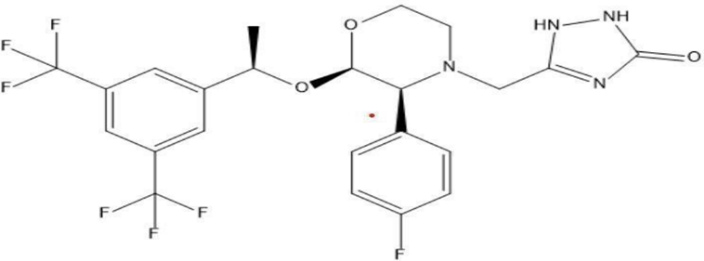
Figure 1: Chemical structure of Aprepitant
Only one method was reported for the determination of APT in presence of its degradation products in oral liquid formulation in the literature. The objective of this work was to develop a new, simple, economic, rapid, precise and accurate HPLC method for quantitative analysis of Aprepitant and to validate the method in accor dance with ICH guidelines Q2(R1)10and apply the method to capsule formulation.
MATERIALS AND METHODS
Aprepitant pure drug (API) was procured from Glenmark Pharmaceuticals Ltd.
EXPERIMENTAL METHODOLOGY PREPARATION OF PHOSPHATE BUFFER
20mM of Phosphate buffer was prepared by dissolving 680.4 mg of potassium dihydrogen orthophosphate in 250 mL of water adjust the pH to 3.0 with 1% of Phosphoric acid. The working mobile phase was prepared in the ratio of 85:15 (Acetonitrile: Phosphate buffer) filtered, degassed and sonicated for 10 min.
PREPARATION OF STANDARD APREPITANT SOLUTION
Accurately weighed 10mg of Aprepitant standard was transferred into 10mL volumetric flask, 3-5mL of Mobile phase was added and sonicated for 5 min to dissolve it completely and the volume was made up to 10ml the volume with mobile phase to get 500µg/mL of standard Aprepitant solution and labelled as STD Stock.
PREPARATION OF SAMPLE APREPITANT SOLUTION
Aprepitant 1 capsule (Aprecap 80) were accurately weighed and their average weight was calculated. Accurately weighed a quantity of powder containing 114mg of Aprepitant and transferred to 10ml volumetric flask, solubilized in 10ml of mobile phase and sonicated for 15mins. After sonication the volume was made up to the 10ml mark with the mobile phase to obtain final concentration of 500µg/mL of Aprepitant and was labelled as ‘SMP STOCK’ and filtered through Whatman Filter paper (#41).
From ‘SMP STOCK’ 5mL was transferred to a 10mL volumetric flask and volume was made up to the mark with mobile phase to obtain a concentration of 500µg/mL of Aprepitant and labelled as ‘FINAL SMP’.
BLANK, FINAL STD STOCK and FINAL SMP solutions were filtered through 0.45µm nylon membrane filter and 20µL was injected into the HPLC system under standardized chromatographic conditions to get a stable baseline and to observe for peak of Aprepitant and any extra peak for 15 mins. The chromatograms obtained is represented.
SELECTION OF ANALYTICAL WAVELENGTH:
Using a Shimadzu 1900i UV-Visible Spectrophotometer, a standard solution of Aprepitant (500 µg/mL) made in a mobile phase of Acetonitrile and 20 mM Phosphate Buffer (pH 3.0) in a 85:15 (v/v) ratio was scanned in the UV range of 200–400 nm. At 264 nm, the highest absorbance (λmax) was recorded.
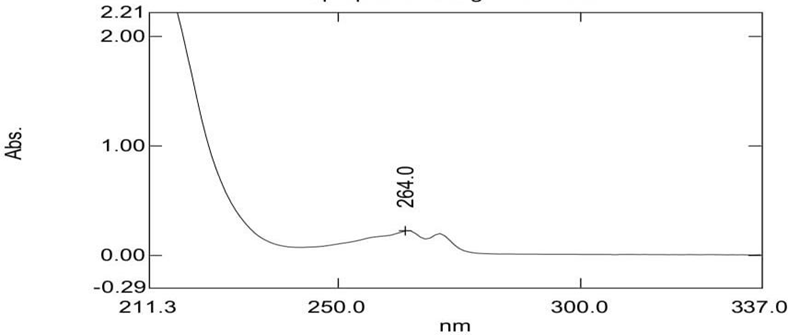
Fig 2: UV Spectra of Aprepitant(500µg/ml)
HPLC CHROMATOGRAPHIC CONDITIONS:
The stationary phase in reversed-phase chromatography was a Phenomenex BDS C18 column (250 mm× 4.6 mm, 5 µm). The mobile phase was made up of 85:15 (v/v) Acetonitrile and phosphate buffer (pH 3.0), filtered through a 0.2 µm nylon membrane, the mobile phase was filtered and sonicated to remove any dissolved gases. 1.0 mL/min was the fixed flow rate. Twenty minutes was set as run duration, and 20 µL of the sample was injected once the column had been equilibrated with the mobile phase, after a stable baseline. A wavelength of 264nm was used for the analyte's detection. The chromatogram is presented in Fig 3.
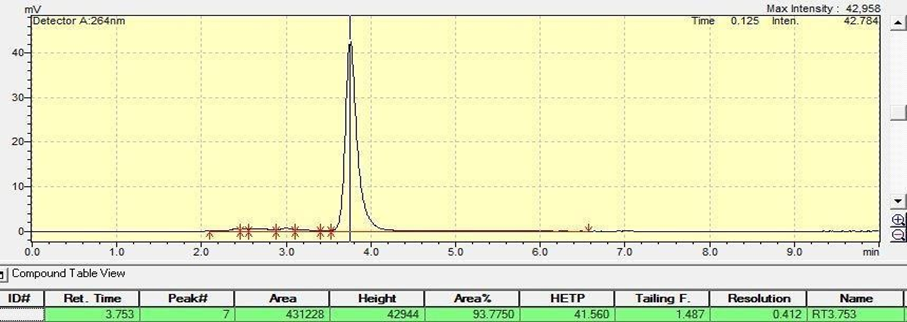
Fig3: Chromatogram for Aprepitant (500µg/ml) in MP containing Acetonitrile: Phosphate buffer 20mM pH 3.0, (85:15) at 264nm
VALIDATION OF RP-HPLC METHOD:
RP-HPLC method developed for determination of Aprepitant was Validated as per ICH guidelines Q2 (R1) for various parameters. Results obtained are presented below.
SPECIFICITY
Specificity was performed to determine that there is no interference of excipients with peak of Aprepitant in standard and sample solutions.
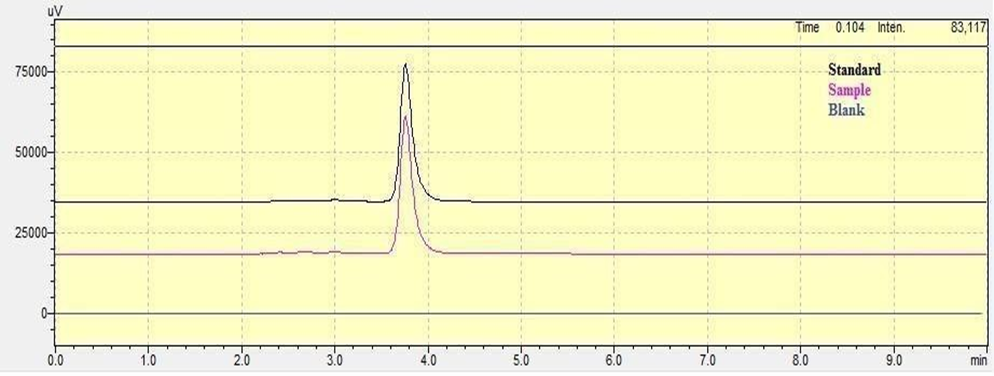
Fig 4: Overlain Chromatogram for specificity studies of Aprepitant (Standard and Sample)
LINEARITY AND RANGE
The linearity of an analytical procedure specifies the results which are directly proportional to the concentration of analyte in the sample. The linearity and range were determined from coefficient of correlation (R2) obtained by plotting AUC vs. CONCENTRATION at 264nm. The results obtained and calibration graph prepared is presented below.
Table 1: Data for concentration and peak area for the linearity studies of Apripetant
|
Sr. No. |
Concentration (µg/mL) |
Area under curve (n=3) |
|
1 |
1000 |
1286552 |
|
2 |
800 |
949354 |
|
3 |
700 |
801567 |
|
4 |
600 |
632813 |
|
5 |
500 |
462228 |
|
6 |
400 |
307345 |
|
7 |
200 |
45175 |
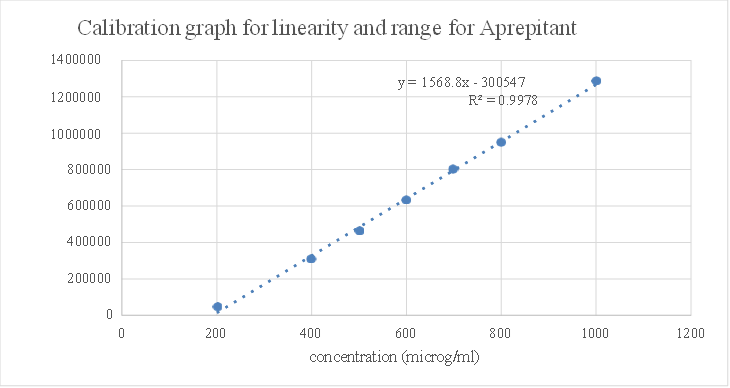
Fig5: Calibration graph for linear ity and range for Aprepitant
Table 2: Linear Regression Analysis Data for Calibration Curve of Apripetant
|
Parameters |
Aprepitant |
|
Linearity & Range (µg/mL) |
200-1000 |
|
Correlation coefficient (R2) |
0.9978 |
|
Slope |
1568.8 |
|
Intercept |
300547 |
LOD and LOQ
The lowest amount that can be detected and quantified was calculated from the respective calibration curve.
The LOD and LOQ were calculated using
LOD = 3.3 × Standard Deviation of Y-intercept
Average slope of six calibration curves
LOQ = 10 × Standard Deviation of Y-intercept
Average slope of six calibration curves
Table 3: Data for LOD and LOQ Studies for Aprepitant
|
Parameter |
Aprepitant |
|
SE |
34601.19 |
|
SD of slope |
415523.8 |
|
LOD(µg/ml) |
39.62952 |
|
LOQ(µg/ml) |
120.0895 |
ACCURACY
Accuracy studies were performed at three different levels (80%, 100% and 120%) and the % Recovery of Aprepitant were calculated and presented below.
Table 4: Percentage Recovery data for accuracy studies at three different levels
|
Drug |
Conc. of STD (µg/ml) (A) |
Conc of Sample (µg/ml) (B) |
Total conc. (A+B) (µg/ml) |
Peak Area* for A+B (µg/ml) (n=3) |
Total amount (A+B) from graph (µg/ml) |
Recovery of Std (µg/ml) |
% Recovery of Std (%w/w) |
|
Aprepitant |
400 |
500 |
900 |
1114011 |
910 |
410 |
102.5 |
|
500 |
500 |
1000 |
1307265.4 |
1016.1 |
516.1 |
103.22 |
|
|
600 |
500 |
1100 |
1418294.9 |
1102.4 |
602.4 |
100.4 |
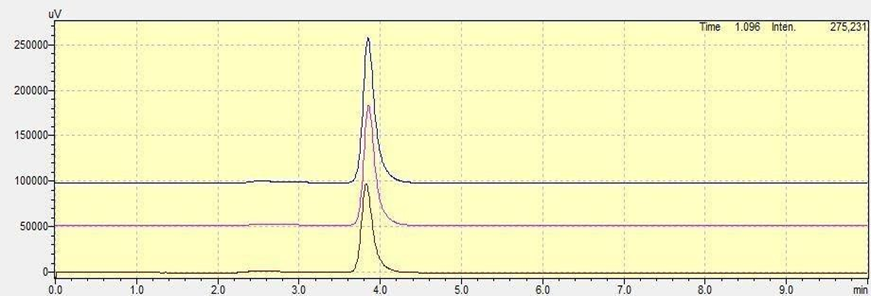
Fig 6: Overlain Chromatogram for Accuracy studies of Aprepitant at three different level
PRECISION
The precision of an analytical method was studied by performing intra-day, inter-day precision, repeatability and reproducibility studies.
Intra- Day and Inter- Day Precision
Intra-Day and Inter- Day Precision was performed to determine whether the developed method gives consistent results at different time intervals on the same day and for three consecutive days. The results obtained have been tabulated below.
Table5: Data for Intra-day and Inter-day precision studies for Aprepitant
|
Aprepitant (500 µg/ml) (n=3) |
|||
|
Intraday |
Interday |
||
|
Time hrs. |
AUC |
Day |
AUC |
|
0 |
426187 |
1 |
421418 |
|
1 |
426780 |
2 |
431228 |
|
2 |
426294 |
3 |
431510 |
|
Mean |
426420.3 |
Mean |
428052 |
|
Standard Deviation |
316.041 |
Standard Deviation |
5746.942 |
|
%RSD |
0.0741 |
%RSD |
1.342 |
REPEATABILITY
The test for repeatability was performed to check whether the developed method gives consistent results with same solution on the same day and same time. The chromatogram and data obtained are presented below.
Table 6: Data for Repeatability studies of Aprepitant
|
Sr. No. |
Aprepitant (500 µg/ml) |
|
|
|
RT (min) |
AUC |
|
1 |
3.668 |
425418 |
|
2 |
3.653 |
431228 |
|
3 |
3.685 |
431510 |
|
4 |
3.670 |
426187 |
|
5 |
3.663 |
426780 |
|
6 |
3.650 |
421294 |
|
MEAN |
3.664833 |
427069.5 |
|
SD |
0.012703 |
3845.97534 |
|
%RSD |
0.346 |
0.901 |
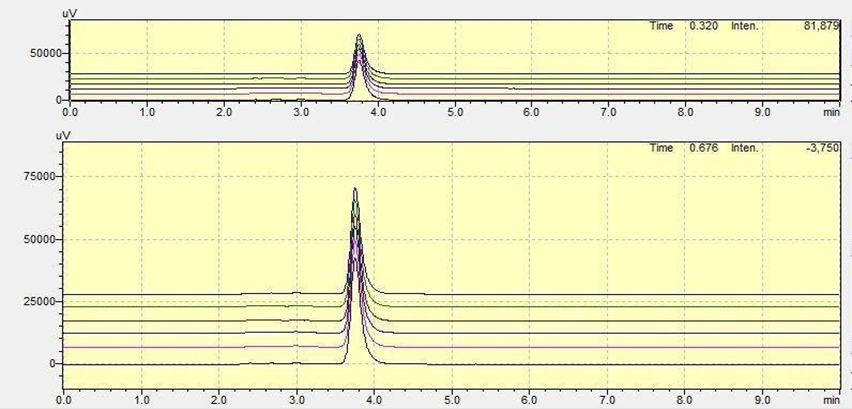
Fig7: Overlain Chromatogram for Repeatability studies of Aprepitant
REPRODUCIBILITY
Reproducibility was performed to ensure that the method is precise when different analysts performed the same analysis with the same method. The results obtained are presented below
Table 7: Data for reproducibility studies of Aprepitant
|
Sr. No |
Analyst 1 (AUC) ( n=3) |
Analyst 2 (AUC) ( n=3) |
|
1 |
425420 |
425421 |
|
2 |
431229 |
431230 |
|
3 |
431513 |
431514 |
|
MEAN |
429387.333 |
429388.333 |
|
SD |
3438.74459 |
3438.74459 |
|
%RSD |
0.8008 |
0.8008 |
ROBUSTNESS
Robustness was evaluated on the basis of system suitability parameters to assess whether the system suitability parameters change with small but deliberate variations. The system suitability parameters for standard solution of Aprepitant were studied with variation in flow rate and organic phase ratio.
Small but deliberate changes in flow rate (±3) were tested and the chromatogram and the data obtained is presented below.
Table 8: Data for variation in Flow rate for Aprepitant
|
Drug |
Acceptance Criteria |
Flow Rate |
||
|
STD (1ml/min) |
+3% (1.03ml/min) |
-3% (0.97ml/min) |
||
|
Aprepitant (n=3) |
TF (≤2.0) |
1.477 |
1.554 |
1.487 |
|
1.487 |
1.513 |
1.483 |
||
|
1.464 |
1.533 |
1.496 |
||
|
%RSD |
0.781 |
1.337 |
0.447 |
|
|
TP (≥2000) |
3597.417 |
4244.732 |
3955 |
|
|
3609.258 |
4287.401 |
3934.534 |
||
|
3586.44 |
4222.497 |
3965.638 |
||
|
%RSD |
0.3172 |
0.7758 |
0.400 |
|
Small but deliberate changes in wavelength (±3nm) was tested and the chromatogram and the dat obtained are presented below:
Table 9: Data for variation in wavelength for Aprepitant
|
Drug |
Acceptance Criteria |
Wavelength (nm) |
||
|
STD (264nm) |
+3 (267nm) |
-3 (261nm) |
||
|
Aprepitant (n=3) |
TF |
1.489 |
1.493 |
1.490 |
|
1.487 |
1.524 |
1.466 |
||
|
1.464 |
1.5100 |
1.460 |
||
|
%RSD |
0.9386 |
1.0287 |
1.0784 |
|
|
TP |
3597.417 |
3598.416 |
3907.312 |
|
|
3609.258 |
3659.254 |
3968.845 |
||
|
3656.440 |
3609.258 |
3983.764 |
||
|
%RSD |
0.862 |
0.895 |
1.025 |
|
SYSTEM SUITABILITY PARAMETERS
Various system suitability parameters such as Retention time (RT), theoretical plates (TP), tailing factor (TF) and area under curve (AUC) were determined from the data obtained. The results are tabulated and presented below:
Table 10: Results of System Suitability parameters for Aprepitant
|
Sr. No. |
Aprepitant (500 µg/ml) |
|||
|
RT (min) |
AUC |
TF |
TP |
|
|
1 |
3.744 |
425418 |
1.528 |
3655 |
|
2 |
3.756 |
431228 |
1.547 |
3636 |
|
3 |
3.740 |
431510 |
1.512 |
3643 |
|
4 |
3.761 |
426187 |
1.509 |
3647 |
|
5 |
3.753 |
426774 |
1.487 |
3629 |
|
6 |
3.746 |
421294 |
1.504 |
3645 |
|
Mean |
3.753333 |
424751.7 |
1.5 |
3649.333 |
|
Standard Deviation |
0.007506 |
3008.777 |
0.011533 |
22.81082 |
|
%RSD |
0.199 |
0.708 |
0.768 |
0.625 |
APPLICATION OF DEVELOPED HPLC METHOD TO CAPSULE DETERMINATION ASSAY OF APREPITANT:
Capsule name: Aprecap 80
Label claim: 80 mg of Aprepitant (Glenmark pharmaceuticals Ltd.)
Determination of Capsule Formulation: Accurately weighed 0.0178 g of powdered drug was taken containing 10mg of Aprepitant and transferred into 10ml volumetric flask and diluted with Mobile phase and sonicated for 5 min and made up the mark with Mobile phase and filtered through 0.25µm Nylon membrane filter. From this 5 mL of the aliquot was pipetted out and transferred into 10ml volumetric flask volume made up to the mark with Mobile Phase which gives the concentration of Aprepitant (500µg/ml) of sample solution was injected into HPLC system at the flow rate of 1ml/min & detected at 264nm. The results obtained are tabulated below.
Table 11: Assay results of Aprepitant in capsule formulation
|
Sr. No. |
AUC* (n=3) |
% Assay (%w/w) (n=3) |
|
1 |
421294 |
99.0 |
|
2 |
421287 |
100.18 |
|
3 |
431228 |
101.36 |
|
MEAN |
424603 |
100.18 |
|
Standard Deviation |
5737.419 |
1.18 |
|
% RSD |
1.351 |
1.177 |
CONCLUSION
A simple and reliable RP-HPLC method was developed and validated for the estimation of Aprepitant in bulk and capsule dosage forms in accordance with ICH Q2(R1) guidelines. The method employed a BRISA LC2 C18 (250 × 4.6 mm, 5 µm) column with a mobile phase of acetonitrile: phosphate buffer (20 mM, pH 3.0) in the ratio of 85:15 v/v, a flow rate of 1 mL/min, an injection volume of 20 µL, and UV detection at 264 nm. The retention time was approximately 3.7 min. The method showed good specificity, linearity in the range of 200–1000 µg/mL (R² = 0.9978), accuracy (100.4–103.22%), and precision (%RSD < 2), with LOD and LOQ of 39.63 µg/mL and 120.09 µg/mL, respectively. Robustness and system suitability results were within acceptable limits. Hence, the developed method is suitable for routine quality control analysis of Aprepitant in bulk and capsule formulations.
Table 12: Results for RP-HPLC method
|
Parameters |
Aprepitant (500?g/ml) |
|
Retention time |
3.753min |
|
Linearity (ug/ml) |
200-1000 |
|
Regression equation (y=mx+c) |
y=1568.8x-300547 |
|
Correlation coefficient (R2) |
0.9978 |
|
LOD (µg/ml) |
39.62952 |
|
LOQ (µg/ml) |
120.0895 |
|
Accuracy (%w/w) Recovery at 80% level) Recovery at 100% level) Recovery at 120% level) |
102.5%w/w 103.22%w/w 100.4%w/w |
|
Precision (%RSD) Intra-day Inter-day |
0.074% 1.342 % |
|
Repeatability(%RSD) |
0.901% |
|
Robustness |
TF, TP were found to be within the acceptance criteria |
|
Analysis of Capsules (%Assay) %w/w |
99-101.36% |
REFERENCES






Dr. Mubeen G, Shiefa Shaikh, Afreen Khanum S, Dr. Tanushree C, Ameena Kousar, Thasma M E, HPLC Quantification of Aprepitant in Bulk and Capsules, Int. J. of Pharm. Sci., 2026, Vol 4, Issue 1, 3097-3106. https://doi.org/10.5281/zenodo.18389895
 10.5281/zenodo.18389895
