
Government College of Pharmacy, Chh. Sambhajinagar
The oral route administration is regarded the most favorable over other routes due to its simplicity, convenience of usage, patient compliance, cost – effectiveness, and painlessness. It is also the safest way of administration. Recent years have seen difficulties with standard dosage forms including patients who are unable to take oral medicament due to dysphasia, unconsciousness, behavioral disorders or CNS abnormalities. So, the first modern alternative to conventional dosage form is to initiate a rapid and swift breakdown in the oral cavity to solve these issues. Mouth dissolving tablets seems to be demanding, promising & one of the most extensively used dosage form over the conventional ones. The development of MDTs aims to provide products with adequate hardness, integrity, taste masking property, pleasant mouth feel, and quick disintegration without needs of water within short time period. Quetiapine fumarate is atypical antipsychotic drug, used in the treatment of schizophrenia and bipolar disorders. Conventional dosage form of Quetiapine fumarate available in the market is not suitable where quick onset of action is required. However, drug is extensively metabolized by the liver, therefore bioavailability is also less. As the antipsychotic patients need to be calm as quickly as possible, the patients are benefited by proposed drug delivery by reaching the drug to the systemic circulation within short time by oral delivery.
Oral route is one of the most frequently utilized methods for administering the medications in the suitable dosage form. Tablets and capsules are mainly administered by oral route. In this approach, the main drawback is difficulty in swallowing dosage forms. A pediatric and geriatric population causes discomfort when swallowing the traditional tablets and capsules via the oral route of administration. To overcome this problem and to make the oral route of administration more convenient for patients, a new drug delivery system has evolved, known as “Mouth Dissolving Tablets” (MDT’s)
Mouth dissolving tablets can be disintegrated, dissolved or suspended in mouth by saliva in matter of seconds without need of water, or can be chewed with the aid of saliva present in the mouth. The primary goal of this formulation is too harsh the bitter taste of medication and cover up the unpleasant odor of the oral formulation. As a drug goes into solution, quicker is the absorption and onset of clinical effect. Some drugs are absorbed from the mouth, pharynx and esophagus as the saliva passes down into the stomach. In such cases, bioavailability of drug is significantly greater than those observed from conventional tablet dosage form.
Quetiapine fumarate is atypical antipsychotic drug, used in the treatment of schizophrenia and bipolar disorders. Conventional dosage form of Quetiapine fumarate available in the market is not suitable where quick onset of action is required. However, drug is extensively metabolized by the liver, therefore bioavailability is also less. As the antipsychotic patients need to be calm as quickly as possible, the patients are benefited by proposed drug delivery by reaching the drug to the systemic circulation within short time by oral delivery. Also, antipsychotic patients are not cooperative; they may hide the conventional tablet under the tongue to avoid the daily dose of antipsychotic drug.
To provide the patients with the most conventional mode of administration, there was a need to develop rapidly disintegrating dosage form, particularly one that disintegrates and dissolve/ disperse in saliva and can be administered without need of water. In the present study, an attempt has been made to develop mouth dissolving tablets of Quetiapine fumarate.
MATERIAL AND METHODS:
Materials:
Quetiapine fumerate was obtained as a gift sample from Alkem Pvt. Ltd. Mumbai. The superdisintegrants (CP, SSG and CCS) were purchase from Hi media Chem Mumbai. Glidant and MCC (PH 102) was purchase from S. D. Fine chemicals Mumbai. The sweetening agent (Aspartame) and Talc were purchase from Research Lab Fine Chem Industries, Mumbai. All other chemicals and reagents used were of analytical grade.
Methods:
All of the formulations contained Quetiapine fumarate, Aspartame, Magnesium Stearate, Talc and different amounts of various superdisintegrants. Superdisintegrants include Crospovidone, Cross Carmellose Sodium and Sodium Starch Glycolate. Pearlitol SD 200 used as directly compressible filler. Composition of various formulations is listed in Table 1.
Tablets were prepared by direct compression- Formulations F1-F9, were prepared by blending each superdisintegrant in three different proportions. The superdisntegrant blends were thoroughly mixed with preset fixed amounts of Quetiapine fumarate, Aspartame, and magnesium stearate, MCC, Talc in a polybag for 30min. The powder mixture, thus prepared, was passed through sieve #40 and then compressed into tablets using 6mm concave punch set.
Table 1: Formulations of Quetiapine fumarate MDT Tablets (in mg) by direct compression.
|
Sr. no. |
Ingredients |
F1 |
F2 |
F3 |
F4 |
F5 |
F6 |
F7 |
F8 |
F9 |
|
1 |
Quetiapine fumarate |
25 |
25 |
25 |
25 |
25 |
25 |
25 |
25 |
25 |
|
2 |
Avicel PH 102 |
2.5 |
2.5 |
2.5 |
5 |
5 |
5 |
7.5 |
7.5 |
7.5 |
|
3 |
Crospovidone |
8 |
12 |
16 |
8 |
12 |
16 |
8 |
12 |
16 |
|
4 |
Pearlitol SD 200 |
59.5 |
55.5 |
51.5 |
57 |
53 |
49 |
54.5 |
50.5 |
46.5 |
|
5 |
Aspartame |
2 |
2 |
2 |
2 |
2 |
2 |
2 |
2 |
2 |
|
6 |
Magnesium stearate |
1.5 |
1.5 |
1.5 |
1.5 |
1.5 |
1.5 |
1.5 |
1.5 |
1.5 |
|
7 |
Talc |
1.5 |
1.5 |
1.5 |
1.5 |
1.5 |
1.5 |
1.5 |
1.5 |
1.5 |
|
|
Total weight (mg) |
100 |
100 |
100 |
100 |
100 |
100 |
100 |
100 |
100 |
Total weight – 100mg/tablet
Preformulation study:
Pre formulation parameters of Quetiapine fumarate were evaluated such as organoleptic properties, melting point and solubility and IR absorption spectrum.
Characterization of powder blends of API and Excipients
The powder blend evaluated for flow properties like angle of repose, bulk density, tapped density, Carr’s index and Hauser’s ratio.
UV Spectrum of Drug
UV spectrophotometer is widely employed for routine drug analysis. Therefore, one of the objectives of the present study was to develop and validate UV spectrophotometric method for analysis of Quetiapine fumarate.
Evaluation Parameters:
Mouth dissolving tablets were evaluated for different tests as:
The weight variation testing was carried out as per the method described in the USP. Twenty tablets were randomly selected and accurately weighed. Results are expressed as mean values ± SD. The following percentage deviation in weight variation is allowed according to USP:
Table 2: Percentage deviation Vs Average weight
|
Average weight |
Percentage deviation |
|
<130 mg |
10 |
|
130-324 |
7.5 |
|
>324 |
5 |
A vernier caliper was used to determine thickness of 10 randomly selected tablets. Results are expressed as mean values.
The friability of tablets was determined using Roche Friabilator. It is expressed in percentage (%). Twenty tablets were initially weighed and transferred into Friabilator. The Friabilator was operated at 25 rpm for 4 minutes or run up to 100 revolutions. The tablets were weighed again.
The % friability was then calculated by the following formula.
P% F = (Initial wt. - Final wt. / Initial wt.) x 100
Percentages Friability of tablets less than 1 % are considered acceptable.
4. Tablet Hardness
The hardness of the tablets was determined using Precision dial type hardness tester. It is expressed in kg/cm2. Three tablets were randomly picked and hardness of the tablets was determined
5. Uniformity of drug content
20 tablets were finely powdered and weight equivalent to 25 mg of Quetiapine Fumarate was dissolved in sufficient quantity of Phosphate buffer (pH 6.8) and assayed for drug content using UV-Visible spectrophotometer at 292.00 nm.
The wetting time characteristic of the loose disintegrant powder allows an evaluation of both the intrinsic swelling and the wettability of the superdisintegrants. Wetting time of the ODT is important parameter which implies a quicker disintegration of the tablet.
A piece of tissue paper of 10cm folded twice was placed in small petri dish of diameter 10 cm containing 10 ml of water. A tablet was put on the paper and the time required for water to reach upper surface of tablet was noted. For water absorption ratio the same wetted tablet was taken out from petri dish and weighed. Water absorption ratio (R) was determined by using following equation.
R=100×Wa- Wb/Wb
Where,
Wb =Weight of tablet before water absorption
Wa = Weight of tablet after water absorption
It is determined by using USP device which consist of 6 glass tubes that are 3 inches long, open at one end and held against 10 mesh screens at the bottom end of basket rack assembly.
To test for disintegration time, one tablet is placed in each tube and the basket arch is positioned in a l litre beaker of water at 37? ± 2? standard motor driven device is used to move the basket assembly up and down. To compliance with the USP standard, all tablets must disintegrate and all particles must pass through the 10 mesh in the time specified.
Dissolution profiles of Quetiapine Fumarate tablets were determined using the USP Method II with paddle speed at 75 rpm. Dissolution was performed in 900 ml phosphate buffer (pH 6.8) maintained at 37?±0.5?. 5ml of samples were withdrawn at specified time intervals. The volume of dissolution fluid was adjusted to 900 ml, by replacing each 5 ml aliquot withdrawn with 5 ml of phosphate buffer, pre- warmed at 37?±0.5?. Samples were withdrawn and analysed at 292 nm, using UV- Visible spectrophotometer. The data presented is the average of 3 individual determinations.Various criteria and Specification for dissolution study was shown in Table 3.
Table 3: Criteria and Specification for Dissolution Study
|
Criteria |
Specifications |
|
Dissolution medium |
900 ml phosphate buffer (pH 6.8) |
|
Temperature |
37?±0.5? |
|
RPM |
75 |
|
Drug Content |
Weight of tablet equivalent to 25mg of drug |
|
Volume Withdrawn |
5ml |
|
Volume made up to |
5ml |
|
λmax |
292 |
|
Beer’s range |
1-20µg/ml |
|
Dilution factor |
No |
Comparison of Optimized F6 Batch with Tablet without Superdisintegrants
In present work, the prepared optimized batch of MDT of Quetiapine Fumarate was compared with the formulation of tablet without superdisintegrants. The tablet was compared with optimized batch for Disintegration and Dissolution.
Results and Discussion:
Preformulation study:
The melting point of Quetiapine was found between the range of 172°C-175°C, indicating purity of drug sample. Solubility studies were carried out in three different medias, phosphate buffer of pH 6.8, 0.1N Hydrochloric acid, and water. The solubility was found maximum in 0.1N Hydrochloric acid as compared to phosphate buffer of pH 6.8 and water.
Drug and Excipient Compatibility Study:
IR Spectroscopy Analysis:

Figure 1: IR spectra of Quetiapine + Crospovidone
Characterization of powder blends of API and Excipients:
Table shows the flow property of each API and Excipients. From these results it was found that the API has poor flow properties but formulation excipients have excellent flow properties except Crospovidone.
Table 4: Flow properties of API and Excipients
|
Parameters density |
Bulk density (g/ml) |
Tapped density (g/ml) |
Carr’s index (%) |
Angle of repose |
Hausner ratio |
Conclusion |
|
Quetiapine fumarate |
0.312 |
0.534 |
28.50 |
55.01 |
1.85 |
Poor flow |
|
Pearlitol SD-200 |
0.85 |
0.89 |
11 |
16.85 |
1.5 |
Excellent flow |
|
Avicel pH 102 |
0.35 |
0.38 |
9.1 |
15.75 |
1.12 |
Excellent flow |
|
Crospovidone |
0.192 |
0.144 |
39 |
42 |
1.45 |
Very poor |
UV Spectrum of Drug in Phosphate Buffer (pH 6.8):
The maximum absorption was found at 292 nm in phosphate buffer (pH 6.8) corresponds to the literature value.
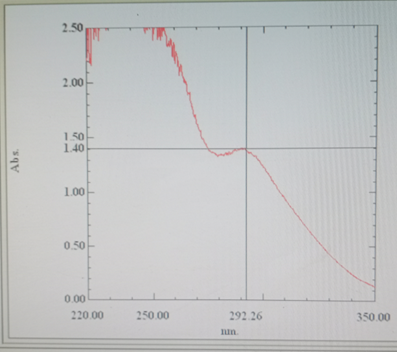
Figure 2: UV Spectrum of Quetiapine Fumarate in Phosphate Buffer (pH 6.8)
Evaluation Parameters:
Table 5: Evaluation of Batches
|
Formulation code |
Weight variation (mg±%SD) |
Hardness (kg/cm2) ±SD |
Friability |
Thickness (mm) ±SD |
DT±SD (sec) |
Wetting time ±SD |
% Drug content |
% DR 30mins |
|
F1 |
100±0.5 |
3.4±0.2 |
0.352 |
2.65±0.3 |
50±1.5 |
55±3 |
98.45 |
81.75 |
|
F2 |
100±0.6 |
3.5±0.5 |
0.411 |
2.65±0.3 |
45±0.5 |
52±0.5 |
98.25 |
82.24 |
|
F3 |
100±0.5 |
3.5±0.4 |
0.356 |
2.65±0.3 |
42±0.5 |
50±0.2 |
99.01 |
82.95 |
|
F4 |
100±0.4 |
3.4±0.5 |
0.305 |
2.65±0.3 |
20±0.3 |
27±0.5 |
100.5 |
86.01 |
|
F5 |
100±0.5 |
3.5±0.5 |
0.425 |
2.65±0.3 |
18±0.5 |
25±0.2 |
100.9 |
87.45 |
|
F6 |
100±0.4 |
3.5±0.5 |
0.355 |
2.65±0.3 |
15±0.3 |
18±0.2 |
100.2 |
89.22 |
|
F7 |
100±0.2 |
3.4±0.5 |
0.253 |
2.65±0.3 |
25±0.5 |
30±0.3 |
99.56 |
83.15 |
|
F8 |
100±0.3 |
3.5±0.5 |
0.20 |
2.65±0.3 |
38±0.5 |
45±0.5 |
99.75 |
84.91 |
|
F9 |
100±0.6 |
3.4±0.5 |
0.50 |
2.65±0.3 |
35.±0.2 |
42±0.4 |
99.23 |
85.44 |
Among all the formulations, F6 containing Crospovidone showed 89.22% drug release within 30 minutes and it showed least disintegration time. Thus, F6 was considered best among the other formulations.
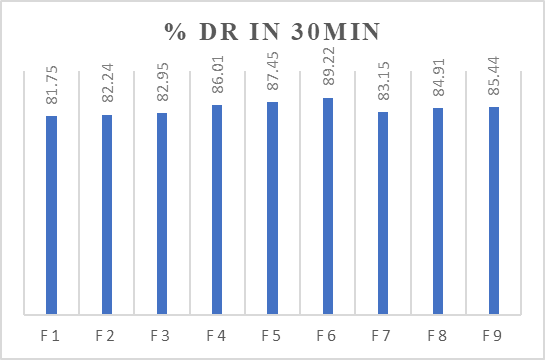
Figure 3: %Drug Release in 30 min
Table 6: Complete Dissolution Profile of Factorial Batches
|
Time (min) |
F1 |
F2 |
F3 |
F4 |
F5 |
F6 |
F7 |
F8 |
F9 |
|
5 |
70.55 |
71.79 |
71.45 |
76.54 |
76.23 |
79.44 |
75.05 |
75.18 |
75.25 |
|
10 |
72.68 |
75.04 |
73.35 |
77.85 |
78.49 |
82.52 |
78.32 |
77.91 |
78.63 |
|
15 |
75.11 |
76.95 |
77.06 |
80.11 |
81.22 |
84.96 |
79.86 |
80.24 |
81.29 |
|
20 |
78.85 |
79.22 |
80.21 |
83.38 |
84.05 |
87.32 |
81.92 |
82.85 |
84.06 |
|
30 |
81.75 |
82.24 |
82.95 |
86.01 |
87.45 |
89.22 |
83.15 |
84.91 |
85.44 |
The disintegration time of tablet without superdisintegrant was found to be 250 seconds and that of F6 batch was 15 seconds. The results were shown in Table 7.
Table 7: Disintegration time of F6 batch and tablet without Superdisintegrant
|
Sr. no |
Parameter |
DT±SD |
|
1 |
Tablet without superdisintegrant |
250 |
|
2 |
F6 formulation |
15 |
In case of dissolution profile of F6 batch, the drug release 89.22% was achieved within 30 minutes, but in case of tablet without superdisintegrant, the drug release was obtained only 60.34 % within 30 minutes.
Table 8: Dissolution profile of tablet without superdisintegrant and F6 formulation
|
Time (min) |
Tablet without superdisintegrant |
F6 formulation |
|
5 |
40.67 |
79.62 |
|
10 |
48.51 |
83.12 |
|
15 |
51.45 |
84.28 |
|
20 |
55.06 |
86.95 |
|
30 |
60.34 |
88.72 |
CONCLUSION:
A mouth dissolving tablet was prepared by using superdisintegrants Crospovidone (CP), Croscarmellose sodium (CCS) and Sodium starch glycolate (SSG) that could dissolve within 30 minutes. The post-compression parameters of all formulations were determined and the values were found to be satisfactory. From the drug content and in-vitro dissolution studies of the formulations, it was concluded that the formulation F6 i.e. the formulation containing Crospovidone is the best formulation.
REFERENCES

Shital Khandagale, Formulation and Evaluation of Mouth Dissolving Tablet of Quetiapine Fumarate, Int. J. of Pharm. Sci., 2026, Vol 4, Issue 1, 1670-1677. https://doi.org/10.5281/zenodo.18273004
 10.5281/zenodo.18273004
