
Shri Vishnu College of Pharmacy (Autonomous),Vishnupur, Bhimavaram-534202, Andhra Pradesh , India
The increasing prevalence of obesity and the associated health problems necessitate the development of effective and safe therapies that also provide nutritional supplements. The preparation and evaluation of a herbal tablet for nutritional supplementation and anti-obesity action is the main focus of this study. A synergistic blend of medicinal plants with proven anti-obesity properties and nutrient-dense profiles is included in the tablet. Standardization of the herbal ingredients was part of the preparation process, followed by the direct compression method of tablet preparation. To confirm the tablet's effectiveness and safety, numerous evaluation tests and other quality control analyses were conducted. According to the findings, this herbal formulation offers a viable substitute for conventional anti-obesity therapies, guaranteeing nutritional supplementation with fewer adverse effects.
A major contributing factor to the rising prevalence of chronic illnesses like diabetes, cardiovascular disease, and metabolic syndrome, obesity is currently a global health emergency.1 Conventional pharmacological interventions for obesity are not able to meet the nutritional needs of obese subjects and are associated with undesirable side effects. As a result, therapies derived from medicinal plants that offer both nutritional and therapeutic advantages are gaining popularity again. This study will create and evaluate a novel herbal tablet for the treatment of obesity and the administration of dietary supplements. 2
Many cultures use the chosen medicinal herbs extensively to control body weight and enhance overall health. The goal of designing the herbs as tablets is to provide a convenient, efficient, and patient-friendly mode of administration. 3 Efficacy and consistency are guaranteed by standardizing herbal materials, and tablets are developed using the direct compression method. The tablets undergo physical, chemical, and biological testing as part of quality control, and the herbal preparation's ability to prevent obesity is also examined. The study's findings highlight the potential of herbal preparations as safe, efficient treatments for obesity that promote weight loss and nutritional improvement. 4
MATERIALS AND METHODS
Materials
Raw drugs employed in this preparation are Moringa oleifera, ginger, garlic, cinnamon, soybean, and honey. These were turned into powdered form. Excipients like lactose, starch, talc, sodium lauryl sulfate (SLS), and magnesium stearate were employed. 5

Image:01 Various excipients used in the formulation
Table: 01 Formulation table of herbal nutrient tablets for obesity treatment
|
SR. NO. |
INGREDIENTS |
F1 (mg) |
F2 (mg) |
F3 (mg) |
F4 (mg) |
|
1 |
MORINGA OLIFERA |
200 |
200 |
200 |
200 |
|
2 |
HONEY |
100 |
100 |
100 |
100 |
|
3 |
GINGER |
50 |
50 |
50 |
50 |
|
4 |
GARLIC |
30 |
30 |
30 |
30 |
|
5 |
CINNAMON |
50 |
50 |
50 |
50 |
|
6 |
SOYABEAN |
10 |
10 |
10 |
10 |
|
7 |
LACTOSE |
40 |
35 |
30 |
25 |
|
8 |
STARCH |
15.5 |
20 |
25 |
30 |
|
9 |
SLS |
1.5 |
2 |
2.5 |
3 |
|
10 |
TALC |
0.5 |
1 |
1.5 |
1.5 |
|
11 |
Mg STERATE |
2.5 |
2 |
1 |
0.5 |
Method of preparation
The tablets are prepared using the direct compression method.
First, the selected herbal ingredients, such as Moringa oleifera, honey, ginger, garlic, cinnamon, and soybean, are combined with excipients like starch, lactose, and talc. All herbal ingredients are thoroughly dried to remove moisture. They are then ground into a fine powder using a grinder, and the powders are passed through a fine mesh sieve to ensure uniform particle size. 6

Each ingredient is weighed accurately according to the formulation requirements. Next, the herbal powders are mixed in a suitable mixer to ensure uniform distribution. The excipients—lactose, starch, and talc—are then added to the blend, which is mixed homogeneously once again.
The flow properties of the powder blend are evaluated, followed by a trial compression test to assess compressibility. The blend is then fed into a tablet press equipped with appropriate tooling, and the compression force is adjusted to achieve the desired hardness and shape. Finally, the compressed tablets are carefully ejected without being damaged. 7
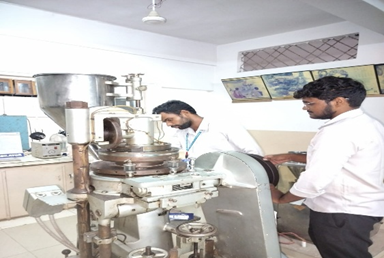
Image:02 Manufacturing of herbal tablets
RESULTS AND DISCUSSION
Evaluation of pre-compressional blend
Angle of Repose
The angle of repose was measured using the fixed funnel method. The fixed funnel method uses a funnel that is fixed with its tip at a certain height h?, above the graph paper that is placed on a level horizontal surface. The granules were carefully pushed through the funnel until the funnel's end met the top of the conical heap. 8
tan θ = h ÷ r
Here, θ stands for the angle of repose, and r is the radius of the conical heap's base.
Bulk density
The ratio of the granule's bulk mass to bulk volume is known as its bulk density. And ρb stands for it. The uniformity of the designated sample for analysis is ascertained using the bulk density.
Apparent density (ρb) = M/Vb
Where M represents the sample's mass, and Vb denotes the bulk volume. 9
Tapped density
The ratio of the granules' weight to the smallest volume they occupy in a measuring cylinder is known as the tapped density. A graduated cylinder with a known mass of the drug or formulation is placed on a mechanical tapper device, which is then run at a fixed number of taps (100) until the powder bed reaches its minimum volume in order to evaluate it.
Tapped density (ρt) is equal to the weight of the powder mixture divided by the cylinder's minimum volume. 10
Carr’s index
Using the observed bulk density and tapped density, the compressibility percentage of the powder blend was calculated using the provided formula. 11
Carr’s index = (Tapped density - Bulk density) × 100 / Tapped Density.
Hausner’s ratio
Hausner’s ratio serves as an indirect measure of powder flowability, where a lower ratio (<1.25) suggests superior flow characteristics compared to a higher ratio (>1.25). 10 It is provided by the equation. 12
Hausner's ratio = Bulk density / Tapped density
Evaluation parameter
Table: 02 Evaluation parameters of tablets
|
Sr. No |
Evaluation parameters |
F1 |
F2 |
F3 |
F4 |
|
1 |
Angle of repose (θ) |
32.3 |
33.4 |
34.2 |
34.7 |
|
2 |
Bulk density (g/ml) |
0.45 |
0.48 |
0.54 |
0.56 |
|
3 |
Tapped density (g/ml) |
0.38 |
0.42 |
0.47 |
0.49 |
|
4 |
Carr’s index |
18.4 |
14.2 |
12.9 |
14.2 |
|
5 |
Hausner’s ratio |
0.844 |
0.875 |
0.87 |
0.87 |
Tablet Dimensions
From each formulation, ten tablets were chosen and assessed for thickness and diameter with a calibrated dial caliper. 13
Weight Variation
Twenty tablets were randomly chosen from the formulation. Each tablet was weighed individually, and then the average weight was determined. The average weight deviation for each tablet was determined, followed by the calculation of the percent deviation. 14
Tablet Hardness
The hardness was assessed using a Monsanto (VHT1, Veego) hardness testing device.
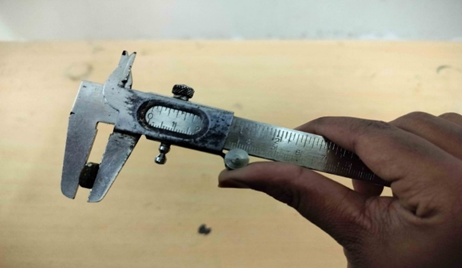
Image: 03 Thickness measurements
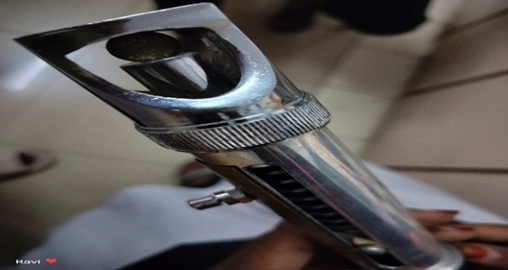
Image: 04 Tablet hardness testing
Friability test
The friability test is conducted using the Friability device. The tablets with weights are positioned in the device. 15 and which has been spun at 25 rpm for 5 minutes. After a period, tablets are removed from the device, and they are measured once more. The formula provided is used to calculate friability.
Friability = (Initial weight (Wi) – Final weight (Wf)) / Initial weight (Wi) * 100
Disintegration test
Six tablets were utilized to assess the disintegration time. The tablets were set in the disintegration device, and the time was recorded until they completely disintegrated. The apparatus temperature was kept at 37ºC, and the average value was obtained for every formulation. 16
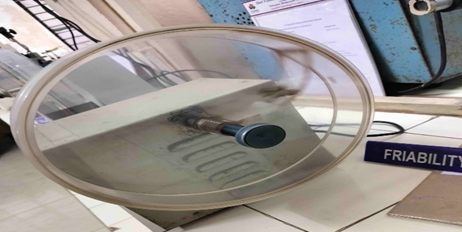
Image: 05 Friability Test

Image: 06 Disintegration Test
Evaluation of Tablets:
The assessment criteria, such as Physical appearance, weight fluctuations, friability, hardness, thickness, and disintegration tests, were performed for the batches, with some results displayed in the Table17
Table: 03 Evaluation parameters
|
Sr. No. |
Evaluation parameters |
F1 |
F2 |
F3 |
F4 |
|
1 |
Thickness (mm) |
0.6 |
0.5 |
0.5 |
0.5 |
|
2 |
Hardness (kg/cm2) |
7 |
7 |
7.5 |
7.4 |
|
3 |
% Weight variation |
3 |
4 |
3.5 |
4.5 |
|
4 |
Friability (%) |
0.5 |
0.1 |
0.2 |
0.4 |
Table: 04 Disintegration of tablets
|
Sr. No |
F1 |
F2 |
F3 |
F4 |
|
1 |
40Mins |
60Mins |
74Mins |
86Mins |
Dissolution Procedure
The dissolution study of the formulated herbal nutrient tablets was conducted to evaluate the in vitro release profile of the active constituents and to ensure their potential bioavailability. The USP Dissolution Apparatus II (paddle method) was employed for this purpose. Dissolution vessels, each containing 900 mL of the selected medium, were maintained at 37 ± 0.5°C using a thermostatically controlled water bath. The medium was chosen based on the solubility characteristics of the herbal constituents; 0.1 N hydrochloric acid was used to simulate gastric conditions, while phosphate buffer pH 6.8 was employed for simulating intestinal pH, ensuring a comprehensive assessment of the dissolution behavior across different gastrointestinal environments.18 Prior to the experiment, the medium was equilibrated to the required temperature to maintain uniform conditions. Each herbal nutrient tablet was carefully introduced into the vessels containing the medium. The paddle rotation speed was set at 50 revolutions per minute, which had been optimized in preliminary trials to provide sufficient agitation without causing tablet disintegration due to mechanical stress. Sampling was carried out at predetermined time intervals of 5, 10, 15, 30, 45, and 60 minutes to monitor the progressive release of bioactive compounds. 19
At each sampling point, 5 mL of dissolution medium was withdrawn from the vessel using a pipette, and an equal volume of fresh, pre-warmed medium was added to maintain a constant volume and hydrodynamic conditions within the vessel. The withdrawn samples were filtered using 0.45 µm membrane filters to remove undissolved particulate matter and prevent interference with analytical measurements.20 The concentrations of the active herbal constituents in each sample were then quantified using UV-Visible spectrophotometry or High-Performance Liquid Chromatography (HPLC), depending on the specific marker compounds present in the formulation. The cumulative percentage release of the bioactive compounds was calculated and plotted against time to obtain the dissolution profile for the tablets. 21 The dissolution curves were analyzed to assess the rate and extent of drug release, and to confirm that the tablets met pharmacopeial standards for in vitro performance. Reproducibility of the results was ensured by performing the study in triplicate for each formulation batch. 22 The dissolution study provided critical insights into the release kinetics, confirming that the herbal nutrient tablets exhibited consistent, predictable release of active constituents over the study period, thereby supporting their potential efficacy in the management of obesity.23
Table: 05 In Vitro Dissolution Profile of Herbal Nutrient Tablets (F1–F4)
|
Time (min) |
% Drug Release – F1 |
% Drug Release – F2 |
% Drug Release – F3 |
% Drug Release – F4 |
|
5 |
12.5 |
15.0 |
14.0 |
16.0 |
|
10 |
25.0 |
28.0 |
27.5 |
30.0 |
|
15 |
38.0 |
40.5 |
39.5 |
43.0 |
|
30 |
55.0 |
60.0 |
58.5 |
63.0 |
|
45 |
72.0 |
78.0 |
75.5 |
80.0 |
|
60 |
85.0 |
90.0 |
88.0 |
92.0 |
|
75 |
93.0 |
96.0 |
94.5 |
97.0 |
|
90 |
98.0 |
99.0 |
97.5 |
99.5 |
|
105 |
100.0 |
100.0 |
100.0 |
100.0 |
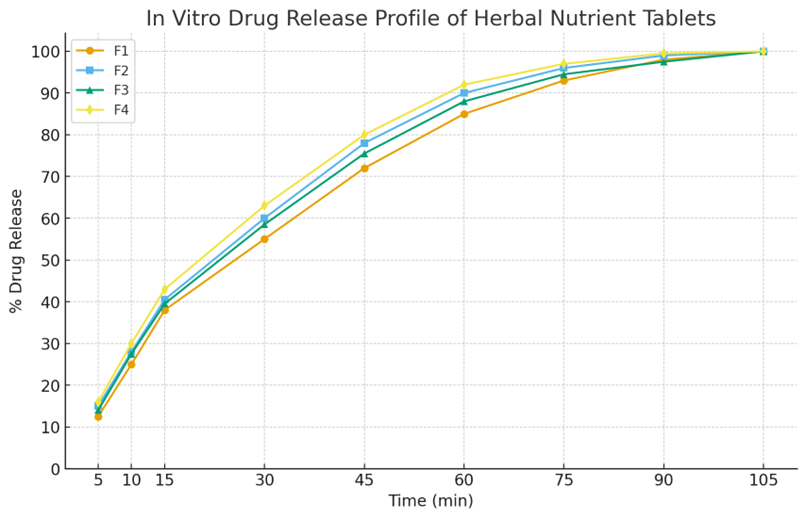
Graph: 01Drug release graph for formulations F1–F4.
It clearly shows the progressive release of the active constituents over 105 minutes, with F4 exhibiting the fastest release and F1 the slowest.
CONCLUSION:
In this study, herbal nutrient tablets were successfully formulated and evaluated for their potential role in obesity management. The selected herbal extracts were incorporated into a tablet matrix, and the prepared tablets were subjected to various quality control parameters, including hardness, friability, disintegration, and dissolution, all of which met pharmacopeial standards. Phytochemical analysis confirmed the presence of bioactive constituents responsible for metabolic enhancement and appetite regulation. Formulation F4 has shown the best dissolution profile when compared with F1,F2 and F3. Stability studies indicated that the tablets maintained their physical and chemical integrity under controlled conditions. In vitro evaluations suggested significant release profiles of active ingredients, ensuring optimal bioavailability. Overall, the formulation demonstrated acceptable mechanical strength, uniformity, and efficacy-related characteristics. The findings highlighted the potential of combining herbal extracts with essential nutrients to support weight management. This study provided a scientific basis for further preclinical and clinical investigations to establish safety, efficacy, and therapeutic benefits in obese populations.
ACKNOWLEDGEMENT
Our sincere thanks to the management and staff of the Shri Vishnu College of Pharmacy (Autonomous) for providing laboratory and library facilities.
FUNDING: Nil
CONFLICT OF INTEREST: Authors declared that there is no conflict of interest among them
REFERENCES


Saikam Ravi Charan Reddy, Pothureddy Hema Madhuri, Yaganti Hema Sri, Sindupilli Bhanu Prasad, Sunkavalli Rama Sanjay, Nagineni Sudarshan Rao, Formulation and Evaluation of Herbal Nutrient Tablet in the Management of Obesity, Int. J. of Pharm. Sci., 2025, Vol 3, Issue 11, 148-155. https://doi.org/10.5281/zenodo.17502400
 10.5281/zenodo.17502400
