
Fabtech College of Pharmacy, Sangola, Solapur, Maharashtra- 413307
Since ancient times, people have utilised plants as an alternative cure for a variety of illnesses. The goal of the current study was to assess Prosopis juliflora's biological activity in vitro, including its haemolytic and antihemolytic effects. Ultrasound-assisted extraction was used to create 80% hydromethanolic and aqueous extracts of the plant's aerial portions. The haemolytic and anti-hemolytic properties of both Prosopis juliflora extracts were evaluated using phytochemical analysis. Both extracts contained tannins, carbohydrates, flavonoids, saponins, and phenolic substances, according to phytochemical screening. Spectrophotometric analysis has been used to assess haemolytic activity. The extracts exhibited a concentration-dependent low haemolytic action on human erythrocytes. At concentrations ranging from 250 to 1000 ?g/ml, the extracts demonstrated a considerable membrane stabilising action against hypotonic-induced haemolysis. By preventing haemolysis caused by H2O2, this study further demonstrated the extracts' possible antioxidant action. At all investigated doses, both extracts demonstrated exceptional antihemolytic action against H2O2-induced haemolysis. The extracts of Prosopis juliflora were found to have anti-hemolytic action and a low haemolytic impact. However, in vivo models must be used to verify these effects.
Prosopis juliflora, the largest and most global of the Prosopis juliflora family, is perhaps the most common in the Mediterranean. It is a member of the Mimosaceae family. This upright annual plant is well-known around the world for its traditional therapeutic purposes, which include headache treatment, antimalarial effects, and general pain reduction. Antioxidant, anticancer, digestive, purgative, emollient, blood purifier, anti-inflammatory, antidiarrheal, diuretic toothache cure, sedative, heart medication, narcotic, and pesticide. Using hypotonic solution and H2O2-induced haemolysis, the study's objective was to screen the plant for its phytochemical contents in aqueous and methanolic extracts and assess the extracts' haemolytic and anti-hemolytic properties in vitro.
ANTIHAEMOLYTIC
Hemolytic Activity
When the membrane of red blood cells (RBCs) is broken, haemoglobin and other internal components are released into the surrounding fluid, a process known as haemolysis. Several hazardous compounds have been screened for using the assessment of in vitro haemolytic activity. The extract contains phytochemicals that may have haemolytic properties. As a result, a number of writers have used in vitro haemolysis experiments to assess the toxicity of various plants.
PROSOPIS JULIFLORA
Prosopis juliflora is a type of mesquite that belongs to the Mimosaceae family of shrubs and small trees. It is indigenous to the Caribbean, South America, and Mexico. In Australia, Asia, Africa, and other places, it has established itself as an invasive weed. The mesquite tree can reach a height of 12 meters (39 feet) with a trunk diameter of up to 1.2 meters (3.9 feet). Its light green, bipinnate, deciduous leaves have 12 to 20 leaflets. Shortly after the formation of leaves, flowers emerge. The blooms are green, yellow, cylindrical spikes that are 5–10 cm long and are found at the tips of branches in clusters of two to five. Each pod contains 10 to 30 seeds and is 20 to 30 cm long. Hundreds of thousands of seeds can be produced by an adult plant. For up to ten years, seeds can still be used. Instead of reproducing vegetatively, the tree uses seeds. Cattle and other animals that eat the seed pods disperse the seeds through their droppings. In an open-pit mine close to Tucson, Arizona, its roots were found in 1960 at a depth of 53 meters (175 feet), demonstrating its ability to grow to a great depth in quest of water. The tree, which is today known as vanni-andara or katuandarain in Sinhala, is thought to have been brought to Sri Lanka in the 1800s. P. juliflora is said to have existed and even been acknowledged as a sacred tree in ancient India, however this is probably a mistake for Prosopis cineraria. The Vanni and Mannar regions are thought to have had the tree for a very long period. The internodes of this species are thornless, but the nodes have pairs of thorns. It might also be nearly thornless.
Forage, wood, and environmental management are some of its applications. The plant's heartwood contains an unusually high concentration of flavanol (-)-mesquitol, which translates to "the unknown." It is known as trupillo orturpío in the Wayuu language, which is spoken in northern Colombia and Venezuela on the La Guajira Peninsula.There are many colloquial names for Prosopis juliflora, but the only commonly used English term is mesquite, which is used for a number of Prosopis species. It is known as bayawonn in Creole, bayarone Française in French, and bayahondablanca in Spanish. Other comparable names, such as bayahonde, bayahonda, and bayarone, can also be applied to any other Neotropical species of the genus Prosopis. Around the world, the tree is referred to by a variety of other names, such as algarrobe, cambrón, cashaw, àinard, mesquite, mostrenco, or mathenge. Since it is the most well-known and prevalent species of Prosopis throughout much of its range, many of the less specific names are just "the" bayahonde, algarrobe, etc. to the locals.Although the term "velvet mesquite" is sometimes used in English, it actually refers to Prosopisvelutina, a distinct species.
About Prosopisjuliflora Plant
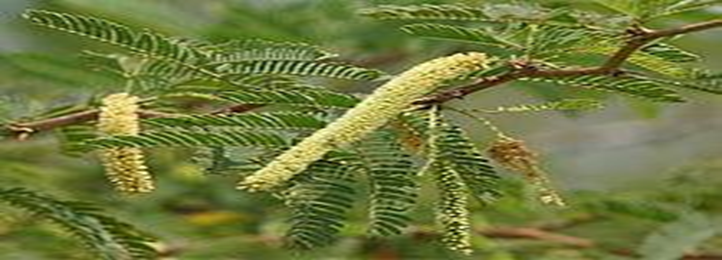
Figure: 1
Significance:
MATERIALS AND METHODS
Plant materials
The leaves of Prosopis juliflora were gathered from a rural part of Vita. Dr. S. M. Shendage, an assistant professor of botany at Balwant College Vita, identified and verified the plant. The leaves of P. juliflora were air-dried for fifteen days in the shade with adequate ventilation before being processed into a fine powder in a mill to prepare extracts.
PHYTOCHEMICAL SCREENING
Test for Alkaloids
|
TEST |
OBSERVATION |
INFERENCE |
|
Mayer’s Test: Mayer's Reagent (potassium mercuric iodide) was applied to the filtrate. |
Formation of a yellow coloured precipitate. |
Alkaloid present. |
|
Wagner’s Test: Wagner's Reagent (iodine in potassium iodide) was used to treat the filtrate. |
Formation of brown/ reddish precipitate. |
Alkaloid present. |
Test for Flavonoids
|
TEST |
OBSERVATION |
INFERENSE |
|
NAOH Test: Aqueous NAOH and HCL were used to treat a little amount of extract. |
Formation of yellow orange colour. |
Flavonoid present. |
|
H2SO4 Test: Conc was applied to a portion of the extract. H2SO4 |
Formation of orange colour. |
Flavonoid present. |
Test for Saponins
|
TEST |
OBSERVATION |
INFERENSE |
|
Foam Test: When 2 grammes of the plant extract and 10 millilitres of distilled water are combined and forcefully shaken, a stable, persistent foam appears, which is a sign that saponins are present. |
No appearance of foam. |
Saponin Absent. |
Test for Steroids and Terpenoids
|
TEST |
OBSERVATION |
INFERENSE |
|
Liebermann – Burchard Test: After treating 4 grammes of extract with 0.5 millilitres of acetic anhydride and 0.5 millilitres of acetic acid, concentrated H2SO4 was gradually added. |
No blue green colour was observed for terpeoids and reddish brown colour for steroids. |
Steroid and Terpenoid Absent. |
Test for Tannins
|
TEST |
OBSRVATION |
INFERENSE |
|
Ferric Chloride Test: In a test tube, 0.5g of the dried powdered sample was cooked in 20ml of water before being filtered. 0.1% FeCl3 was added in a few drops. |
Brownish green black or blue black colouration. |
Tannin Present. |
|
Lead Acetate Test: 2ml of distilled water were mixed with two millilitres of plant extract. This mixture was mixed with 0.01g of lead acetate and thoroughly shaken. The presence of tannins is indicated by the development of white turbidity and precipitate. |
Development of white turbidity and precipitate. |
Tannins present. |
Test for Phenols
|
TEST |
OBSERVATION |
INFERENCE |
|
Ferric Chloride Test: Ten millilitres of plant extract were heated to between 450 and 500 degrees Celsius in water. Next, 0.3% FeCl3 was added in 2 millilitres. |
No formation of green or blue colour. |
Phenol Absent. |
Test for Glycosides
|
TEST |
OBSERVATION |
INFERENSE |
|
Fehling's Test: Fehling's Remedy A and B were simmered for one minute after being diluted with distilled water. Eight drops of plant extract were added to this clear blue solution. It was then combined with 1 ml of Fehling's solution and heated for 5 minutes in a water bath. The presence of glycosides is indicated by the production of brick-red precipitate. |
The formation of brick red precipitation. |
Glycosides Present. |
REAGENT PREPARATION
Ethanol
Sodium Chloride
WORKING PROCEDURE
Absorbance of control) x 100
Protection % = 100 (Hemolysis)
OBSERVATION
Table No. 1 Absorbance of Sample
|
Sr. No. |
Concentration |
Observation (nm) |
Hemolysis % |
Protection % |
|
1 |
25 |
0.134 |
81 % |
19 |
|
2 |
50 |
0.402 |
2.45 % |
-145 |
|
3 |
75 |
1.354 |
8.25 % |
-725 |
RESULT
The percentagenitric oxide scavenging antihemolytic activity of ethanolic extract of Prosopisjuliflorais presented in Table 1.The ethanolic extract of Prosopis juliflora exhibited a maximumnitric Hemolysis % antihemolytic activity 81%.The phytochemical analysis of crude ethanolic extract of P. juliflora(leaves) performed by the method described earlier and then analyzed for phytocompounds like steroids or terpenoids, alkaloids, flavonoids, coumarins, saponins, tannins and anthraquinone preliminary analyzed, showed the presence of alkaloids, flavonoid, tannins, glycosides except saponins and Unsaturated Sterol And/or Triterpenes were absent.
|
Sr. no |
Concentration |
Hemolysis % |
|
1 |
25 |
81% |
|
2 |
50 |
2.45% |
|
3 |
75 |
8.25% |
CONCLUSION
The ethanolic extract of Prosopis juliflora having anti antihemolytic activity this may be useful in treatment blood and clotting related disorders.
REFERENCES
profile.A review Phcog Rev 2009; 3:364 74.
profile.A review Phcog Rev 2009; 3:364 74.


Amol Pore, Gopika Dongare, Sanjay Bais, Evaluation of Antihemolytic Activity by Prosopis Juliflora, Int. J. of Pharm. Sci., 2026, Vol 4, Issue 2, 2979-2984. https://doi.org/10.5281/zenodo.18692034
 10.5281/zenodo.18692034
