
Department of Pharmaceutics, Dayanand Education Society’s Dayanand College of Pharmacy, Latur, India.
Emulgel is a topical drug delivery system with the advantages of emulsions and gels, and especially useful for delivery of poorly water-soluble (hydrophobic) drugs through the skin. The latest developments in emulgel formulations are reviewed, including their composition, types, methods of preparation, evaluation parameters, and therapeutic applications. Emulgels enhance drug penetration, spreadability, stability, and patient compliance without first-pass metabolism. The selection of various gelling agents, emulsifiers, and penetration enhancers plays a vital role in improving drug release and skin absorption. Emulgel systems have better drug loading, controlled release, and cosmetic acceptability, compared to conventional topical formulations, such as creams and ointments. Emulgel systems are an emerging and patient-friendly topical drug delivery system with potential applications in pharmaceutical and cosmetic industries.
Topical drug delivery, which can be used for the treatment of many different cutaneous conditions, is a useful approach when other administration routes are ineffective or not suitable for the condition, such as in the case of localized infections such as fungal infections.1 Drug delivered via this route bypasses first-pass metabolism and reaches the target site by penetration of the skin. The release of drugs from this system is highly dependent on the nature of the carrier system, but because of the small size of the microemulsion droplets, they provide advantages due to their ability to penetrate the skin and diffuse the drug. Microemulsions are also important in topical delivery because of their ability to provide sustained release and are incorporated into gels to provide drug retention on the skin surface2.
1.1 What are drug Delivery systems?
Drug delivery systems are the mechanisms by which a pharmaceutical compound is delivered throughout the body to produce a therapeutic effect; these systems regulate the rate, timing, and location of drug release to maximize efficacy and reduce side effects. Oral tablets and suppositories are common delivery methods, and both typically have a coating or matrix to protect the drug from degradation and ensure that the drug arrives at the site of action. New drug delivery systems include nanoparticle-based systems, which encapsulate drugs within small carriers for increased stability, targeting, and controlled release.3
1.2 Types of drug delivery systems:
1.3 Introduction of Emulgel
An emulgel is a topical drug delivery system that is prepared by converting an emulsion into a gel using a gelling agent; it can be formulated as either an oil-in-water or water-in-oil type. Emulgels combine the properties of emulsions and gels and, unlike plain gels, can deliver hydrophobic drugs while still providing the cooling and soothing effect of gels. Since emulgels contain both aqueous and oily phases, they are suitable for delivering both hydrophilic and lipophilic drugs, possess good spreadability and are non-greasy, stable, odorless, and have a pleasant appearance, which makes the drug more acceptable by the patient; emulgels also have a greater drug-loading capacity than conventional topical formulations. Emulgels have become increasingly important as controlled-release drug delivery systems; the biphasic nature of emulgels aids sustained drug release and improved stability, making them a promising drug delivery system.4
Emulsion + Gel = EMULGEL
1.4 Advantages of Emulgel:
High spreadability and self-application.
Improved patient compliance.
Suitable for drugs with a short half-life.
Suitable for potent drugs.
Low preparation cost.
Better drug loading.
Production feasibility.
Easily washable and nonstaining.
Avoids first-pass metabolism.5
1.5 Disadvantages of Emulgel:
Potential for contact dermatitis or skin irritation
Risk of allergic reactions
Some drugs have poor permeability through the skin
Occurrence of bubbles during emulgel formation
Skin irritation or allergic reactions in contact dermatitis.6
1.6 Types of Emulgel
Emulsions are of different types depending on the size of droplets or nature of distribution
1) Macroemulsion gel
2) Nano emulsion gel
3) Microemulsion gel
1) Macroemulsion gel:
These are the most common emulgels, characterized by emulsion droplets larger than 400 nm. Although they appear solid to the naked eye, microscopic examination reveals the tiny droplets composing them. Macroemulsions are thermodynamically unstable but can be stabilized using surfactants. For example, Khullar R. et al. developed a mefenamic acid emulgel using Carbopol 940 as the gelling agent, liquid paraffin as the oil phase, and mentha and clove oils as penetration enhancers. The formulation was evaluated for rheological properties, spreading coefficient, skin irritation, and in vitro drug release.
2) Nano emulsion gel:
These are the most common emulgels, containing droplets of emulsions greater than 400 nm, which appear solid to the naked eye but are composed of microscopic droplets. Macroemulsions are thermodynamically unstable, and they can be stabilized with surfactants. For instance, Khullar R. et al. prepared a mefenamic acid emulgel using Carbopol 940 as the gelling agent, liquid paraffin as the oil phase, and mentha and clove oils as penetration enhancers, which were evaluated for rheological properties, spreading coefficient, skin irritation, and in vitro drug release.
3) Microemulsion gel:
A nanoemulgel is a clear or slightly opaque system of very small droplets (less than 100 nm), stabilized by surfactants, and it is an oil-in-water system that is formed by the addition of a nanoemulsion into a gel. Due to the small droplet size of nanoemulsions, the drug penetration through the skin is much higher than that seen with the conventional creams, gels, ointments, or emulsions; hence, nanoemulgels are more efficient.7
1.7 Factors Affecting Topical Absorption of Drug
1.7.1 Physiological Factors
Thickness of the skin
Content of lipids.
Sweat gland density is a measure of the density of sweat glands.
The pH of your skin.
The flow of blood.
Skin hydration is important for maintaining skin health .
The skin is inflamed.
1.7.2 Physiochemical Factors
Partition coefficient.
Molecular weight of less than400 Dalton.
Degree of ionization (only unionized drugs are absorbed well).
Effect of vehicles.8
2. Rationale of Emulgel Formulation
Emulgel Formulation: Traditional topical formulations such as ointments, creams, and lotions suffer from stickiness, poor spreadability, and lack of stability, and so transparent gels have become increasingly popular in both cosmetics and pharmaceuticals.
Gels are primarily about 99 percent liquid that is held together by a network of gelling agents, but they are unable to deliver hydrophobic (water-repelling) drugs efficiently, so emulsion-based gels (emulgels) are used to deliver both hydrophilic and lipophilic drugs through the skin.
In many cases, medicated products are applied topically to either supplement or replenish important skin functions or to pharmacologically alter underlying tissue activity.9
3. Anatomy of Skin
Human skin manually comprises three dependent tissues:
Epidermis, Dermis, Hypodermis10
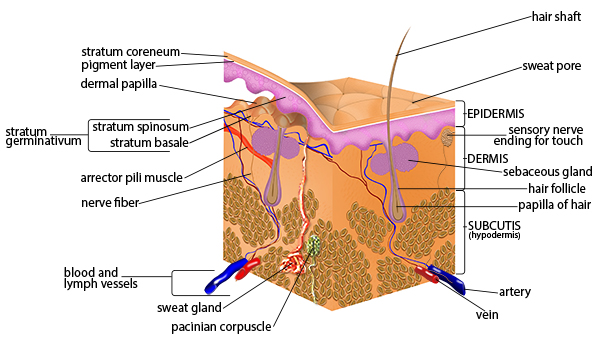
Fig.1: Anatomy of Skin11
3.1. Epidermis:
The epidermis of the skin is formed by a stratified epithelium, which is composed of five layers:
Stratum cornea
Stratum lucidum
Stratum granulosum
Stratum germinativum
The most important feature of the epidermis is that it does not have blood vessels. The capillaries of the dermis provide nutrition. The epidermis is a stratified, squamous, keratinizing epithelium that is the topmost layer of the skin. More than 90% of the skin is composed of keratinocytes, which are responsible for the barrier characteristics of the skin.12
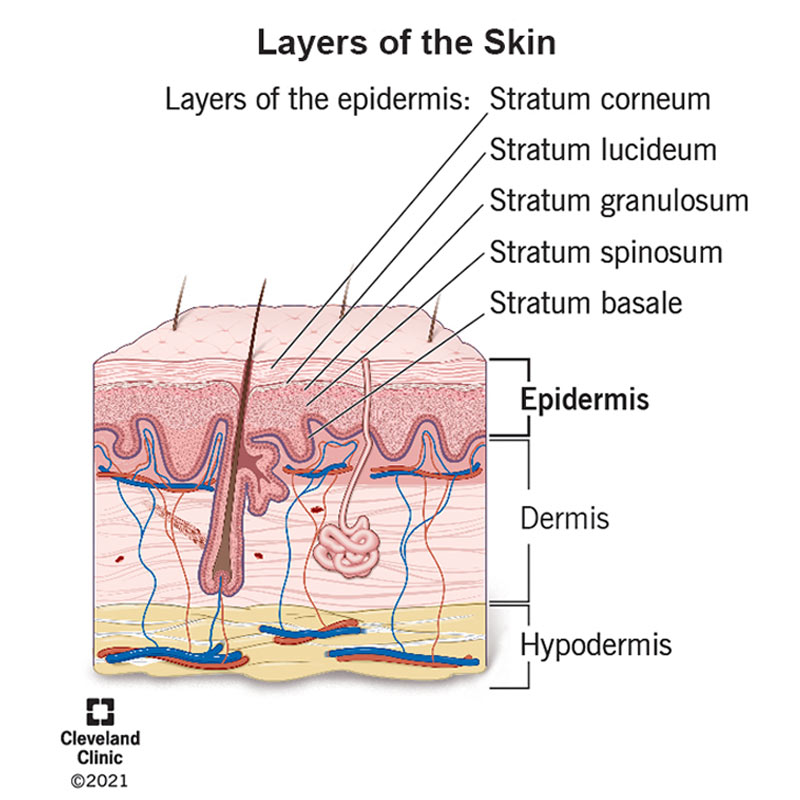
Fig. 2. Epidermal Layer of the Skin13
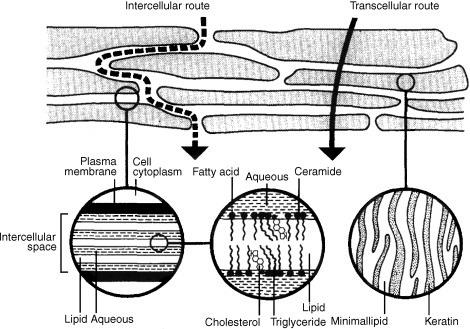
Fig. 3. Structure OF Stratum Corneum
3.2. Dermis:
The dermis is the middle, or thick layer of the skin, and is made up of collagen, elastin, and fibrillin, which give the skin strength and elasticity; it has nerves, sweat glands, oil glands, hair follicles, and blood vessels. The dermis is a vascular layer with a ground substance that is gel-like and maintains the health and softness of the skin.14
3.3. Hypodermis:
The hypodermis is the deepest layer of the skin, which attaches the skin to the bones and muscles; it contains sebaceous glands, sweat glands, and hair follicles. Sebaceous glands release sebum, an oily substance that lubricates the skin and hair, preventing dryness and making the skin waterproof. Sweat glands secrete a dilute salt solution that evaporates and cools the body to regulate body temperature.15
4. Formulation of Emulgel
4.1. Vehicle
Properties of vehicles is that
The drug is delivered to the target site.
Sustain a therapeutic drug level in the target tissue for a sufficient duration to provide a pharmacological effect.
The drug is then released to allow it to migrate freely to the site of action.
Aqueous material
This forms an aqueous phase in the emulsion. Commonly used agents include water and alcohols.
Mineral oils are commonly used alone or with soft or hard paraffin for emulsions used on the skin. For oral emulsions, mineral and castor oils act as laxatives, whereas fish liver and vegetable oils are used as nutritional supplements.
4.2. Emulsifier
Emulsifying agents are used to promote emulsification during manufacture and to control stability during shelf life. For example, polyethylene glycol 40 stearate, sorbitan mono-oleate (Span 80), Polyoxymethylene Sorbitan monooleate (Tween 80), stearic acid, and sodium stearate.
4.3. Gelling agent
Gelling agents thicken the formulation and provide a gel-like texture. They can be natural or synthetic and make the system thixotropic (thin when shaken and thick when still). When gelling agents were added, a higher concentration resulted in less drug release. Carbopol swells in water and is suitable for controlled drug release, whereas HPMC provides better drug release than carbopol. E.g.: Carbopol-934 (1%), HPMC-2910 (2.5%).
4.4. Preservatives:
E.g.: Propyl paraben, methyl paraben.
4.5. Antioxidants:
Examples include butylated hydroxytoluene (BHT), ascorbyl palmitate, and Butylated Hydroxyanisole (BHA), etc.
4.6. Humectants:
This was done to prevent moisture loss. E.g. Glycerine, Propylene glycol, etc.
4.7. Gelling agents:
These agents are used to increase the consistency of any dosage form and can also be used as thickening agents. E.g. Carbopol 934, carbopol 940, HPMC, HPMC-2910, and sodium
5. Permeation enhancer:
These agents partition into and interact with skin constituents to induce a temporary and reversible increase in skin permeability. Examples include oleic acid, lecithin, isopropyl myristate, urea, eucalyptus oil, Chenopodium oil, pyrrolidone, laurocapram, dimethyl sulfoxide, linoleic acid.16
6. Properties of Penetration Enhancers:
They should be non-toxic, non-irritating, and non-allergenic.
They should have no pharmacological activity within the body i.e. should not bind to receptor sites.
They would ideally work rapidly, and the activity and duration of the effect should be both predictable and reproducible.
The penetration enhancers should be appropriate for formulation into diverse topical preparations and should be compatible with both excipients and drugs.
They should be cosmetically suitable with an appropriate skin 'feel.'17
7. Method of Preparation of Emulgel:
7.1. Method No.01
It consists of 3 steps
Step-1: formulation of emulsion, either o/w or w/o preparation of oil phase:
The oil phase of the emulsion was prepared by dissolving the emulsifier.
For example, span 20 in the oil phase lies in light liquid paraffin.
Preparation of the aqueous phase:
The aqueous phase was prepared by dissolving the emulsifier. E.g.: Tween 20 in purified water.
Step-2: Formulation of gel base:
prepared by dispersing polymer in purified water with constant stirring at a moderate speed using mechanical shaker, then the pH was adjusted to 6- 6.5 using tri ethanolamine (TEA).
Step-3: Incorporation of emulsion into gel base:
Add glutaraldehyde in during mixing of gel and emulsion in ratio of 1:1 to obtain emulgel.18
7.2. Method No.02 19
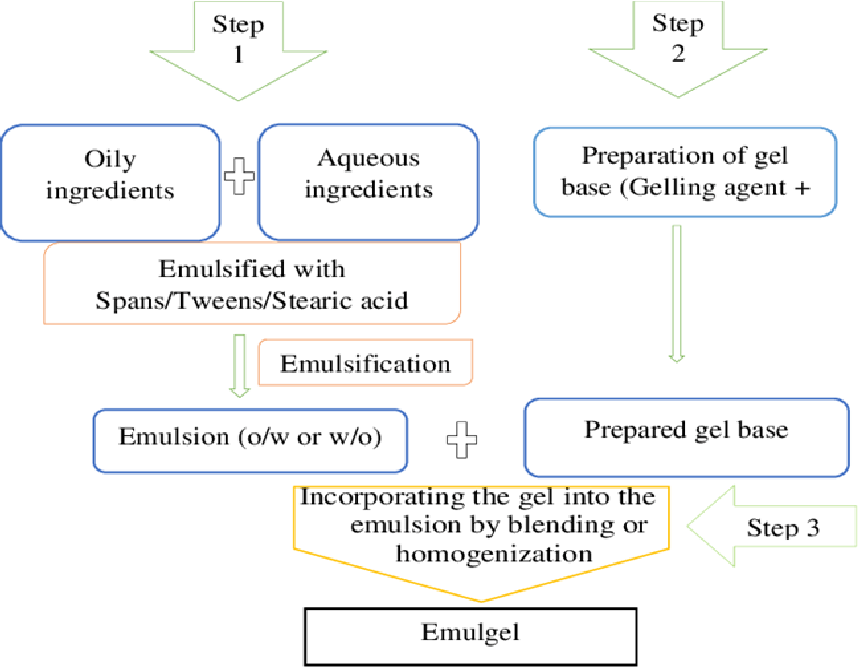
8. Evaluation Parameters
8.1. Physical appearance:
The prepared Emulgel formulations were examined visually for their color, homogeneity, consistency, and pH. The pH 1% aqueous solutions of the prepared Gellified Emulsion were measured by a pH meter.
8.2. Spreadability:
Spreadability is determined by equipment used in the lab and is most often determined by a method suggested by Multimer et al (1956) using the spreadability of an emulgel, which is the ease of spreading of the emulgel on the skin; a 2 g amount of emulgel is placed between two glass slides and a 1 kg weight is applied to them for 5 minutes to ensure a thin, uniform layer with no air entrainment; the top slide is pulled with an 80 g weight, and the time it takes to move 7.5 cm is recorded.20
Spreadability was calculated by this formula,
S= M.L/T
Where,
S = spreadability,
M = Weight tied to higher slide,
L = Length of glass slides
T = Time taken to separate the slides from one another.
8.3. Rheological Study:
The viscosity of the different emulgel formulations was determined at 25°C using a cone and plate measuring system with a 52-spindle connected to a thermostatically controlled circulating water bath.
8.4. Swelling Index:
The swelling index of ready topical emulgel was determined by placing one gram of the gel on a porous foil, placed individually in a 50 cm3 beaker containing 10 cm30.1 N NaOH, removed from the beakers at various time intervals, and dried at room temperature for a few minutes, and reweighed.21
The swelling index is calculated as follows:
Swelling Index (SW) % = [(Wt – Wo)/ Wo] ×100.
where,
(SW) % = Equilibrium share swelling,
Wo = Original weight of emulgel at zero time once time t,
Wt. = Weight of swollen emulgel
8.5. Globule size and its distribution in emulgel:
Globule size and distribution were determined by the Malvern sizer. A 1 gm sample was dissolved in purified water and agitated to encourage homogeneous dispersion. The sample was injected into a photocell of a zeta sizer. Globule diameter and distribution were determined.
8.6. Drug Content Determination:
Drug content was measured by a spectrophotometer. The drug content of Gellified Emulsion was determined by dissolving Gellified Emulsion in solvent (methanol) by sonication and measured absorbance after appropriate dilution in a UV photometer.22
8.7. Microbiological assay:
We used the ditch plate technique, which is used to determine the organic process or fungistatic activity of a compound, primarily for solid formulations. We used previously prepared dried Sabouraud’s agar plates. 3 grams of the Gellified emulsion are added to a ditch cut in the plate. Culture loops are prepared and the percentage inhibition was measured as follows.
percentage inhibition = L2 / L1 × 100
where,
L1 = total length of the patterned culture
L2 =length of inhibition.
8.8. Skin irritation test:
A 0.5-gram sample of the test article was then introduced under a double layer of gauze to an area of skin approximately 1" x 1" on two sites per rabbit. The gellified emulsion was applied to the skin of the rabbit. Animals were returned to their cages. The test sites were wiped with tap water to remove the test article residue.
8.9. In-Vitro release Study:
The release of the drug was studied using a Franz diffusion cell where a small amount (200 mg) of the gellified emulsion was spread onto an egg membrane placed between the donor and receptor chambers. The receptor chamber was filled with PBS (pH 5.5) and stirred continuously, and 1 ml samples were taken at set time intervals and analyzed using a UV-visible spectrophotometer to measure drug content. The total amount of drug released was calculated after correcting for the removed samples.
9. List of marketed products:23
List of Marketed Products
|
Marketed Formulation |
API |
Use |
|
Voltarol |
Diclofenac diethyl ammonium |
Anti-inflammatory |
|
Diclomax Emulgel |
Diclofenac sodium |
Anti-inflammatory |
|
Denacine Emulgel |
Clindamycin phosphate |
Antibiotic |
|
Cataflamemulgel |
Diclofenac potassium |
Anti-inflammatory |
|
Isofenemulgel |
Ibuprofen |
Anti-inflammatory |
Current Investigation of Emulgel using different drugs:
Current Investigation of Emulgel Using Different Drugs
|
Drug |
Aim |
Use |
Reference |
|
Ketoprofen
|
Formulation of in-vitro and in-vivo evaluation of microemulsion-based gel loaded with ketoprofen. |
Anti-inflammatory.
|
(24)
|
|
Meloxicam
|
Formulation and characterization of Meloxicam loaded emulgel for topical application. |
Anti-inflammatory.
|
(25)
|
|
Piroxicam |
Effects of various |
Anti-inflammatory. |
(26) |
|
Naproxen-Eugenol
|
Fabrication and Characterizations of Pharmaceutical Emulgel Co-Loaded with Naproxen-Eugenol for Improved Analgesic and Anti-Inflammatory Effects |
Anti-inflammatory.
|
(27)
|
|
dexibuprofen |
Formulation design, development and characterization of dexibuprofen emulgel for topical delivery: In-vitro and In-vivo evaluation |
Local anti-inflammatory and pain-relieving |
(28)
|
|
Oxiconazole
|
Formulation of oxiconazole emulgel for topical drug delivery. |
Fungal infection.
|
(29)
|
|
allopurinol |
Design and development of allopurinol emulgel |
In treatment of gout. |
(30) |
Recent Research Articles Published on Herbal Emulgel:
Shikha Baghel Chauhan DOI: 10.5958/0974-360X.2020.00636.8
0In this article they were performed that the study aim of the developing a stable and easily manufactured emulgel including green tea extract and avocado oil that is effective on the barrier function and hydration of the skin. An Emulgel containing green tea extract and avocado oil was developed which had the promising potential to be used for Acne treatment. Their results came to be the a cosmetically acceptable, stable and effective emulgel formulation for the skin barrier function with good hydrating properties was obtained for skin hydration, protection and anti-acne purposes.31
Rachit Kumar, Deepinder Kumar DOI: 10.1016/j.jsps.2011.08.001
In this article they were performed that the study aim of the Formulation and Evaluation of Mefenamic acid emulgel for topical delivery. Emulgel of mefenamic acid, a NSAID, using Carbopol 940 as a gelling agent and mentha oil and clove oil were used as a penetration enhancer. The topical emulgels of mefenamic acid was formulated and subjected to physiochemical studies i.e. rheological studies, spreading coefficient studies, bio-adhesion strength, skin irritation studies, in-vitro and in-vivo release studies, anti-inflammatory activity and analgesic activity.32
P. Vijaya Bhanu, V. Shanmugam and P. K. Lakshmi www.pharmacie-globale.info
In this article they were performed that the study of Development and Optimization of Novel Diclofenac Emulgel for Topical Drug Delivery. Diclofenac dimethylamine is a non-inflammatory drug, used in the treatment of inflammation and degenerative disorder of the musculoskeletal system. Initially they were prepared to emulgel concludes that the formulation developed shows its physicochemical properties like spreadability, homogeneity, viscosity and consistency are good. All the results were comparable with the marketed sample and the drug content also within BP limit. Permeability study shows that DFG 11 and DFG 02 have comparable drug release with that of marketed product.33
Meenakshi Bhatia, Pooja Rani, Neelam Sihag, Samiksha Grewal DOI: 10.31838/ijprt/15.01.06
In this article they were performed that the study of Formulation, Optimization and Evaluation: Piroxicam Emulgel for Topical Drug Delivery Systems. In that article the Piroxicam is nonsteroidal anti-inflammatory drug that is classified as BCS II drug (low solubility and high permeability). However, optimized piroxicam Emulgel showed good physical properties, high drug release, strong anti-inflammatory effect, and good adhesion. Hence, Piroxicam when loaded in emulgel can be administered topically with improved properties.34
11.5. Disha Nailwl, Himansu Chopra, Alankar Shrivastav, Dr. Yusra Ahmad Year-2019 at http://jddtonline.info
In this article they were pe0rformed the aim of the study of formulation and evaluation of vegetable oil (sesame oil) and compare with liquid paraffin Fluconazole emulgel. Fluconazole is an anti-fungal medication use for a number of fungal infections. The prepared emulgel were also evaluated for their physical propertied, pH, drug content, viscosity, spreadability and swelling index. The pH of formulation with liquid paraffin and vegetable oil. It was concluded that vegetable oil based emulgel are stable and effective and can be used instead of liquid based emulgel.35
CONCLUSION
Emulgel has emerged as an effective and innovative topical drug delivery system that combines the advantages of both emulsions and gels. It is particularly beneficial for the delivery of hydrophobic drugs, which have poor solubility in aqueous gel bases. The incorporation of an emulsion into a gel base improves the stability, spreadability, and patient acceptability of the formulation. Emulgels also provide controlled drug release, enhanced skin penetration, and reduced greasiness compared to conventional ointments and creams.
The formulation of emulgel involves careful selection of polymers, emulsifying agents, penetration enhancers, and other excipients to achieve desirable physicochemical properties and therapeutic effectiveness. Various evaluation parameters such as pH, viscosity, spreadability, drug content, and in-vitro drug release play an important role in determining the quality and performance of the formulation.
In recent years, emulgel has gained significant attention in pharmaceutical research for the treatment of various conditions such as inflammation, fungal infections, acne, and pain management. Herbal drugs and plant extracts are also being successfully incorporated into emulgel formulations to enhance their therapeutic benefits while minimizing side effects.
Therefore, emulgel formulations represent a promising approach in topical drug delivery systems. With continuous research and development, emulgels are expected to play an important role in improving drug therapy, enhancing patient compliance, and expanding their applications in both pharmaceutical and cosmetic industries.
REFERENCES




Shravani Rode, Archana Yelmate, Kranti Satpute, Rutuja Panchal, Aditee Agashe, A Review on Advances in Emulgel Preparation for Topical Drug Delivery, Int. J. of Pharm. Sci., 2026, Vol 4, Issue 3, 3861-3872, https://doi.org/10.5281/zenodo.19333335
 10.5281/zenodo.19333335
